Get the information you need for academic planning and connect with experiences to develop the knowledge, skills and attributes that employers are seeking.

This resource is meant as a guide to provide suggestions throughout your time at university (refer to the Academic Calendar for a complete list of program requirements). Develop a plan and timeline that suits you best. Make intentional choices for your courses and work experiences.

  • Photo of Prairie Skye Young-Brown
  • Student spotlight

    "I was always interested in social justice and particularly Indigenous and queer issues. Sociology allowed me to focus in on the issues close to my heart and gave me the tools to discuss and argue effectively. The best thing about the department is you can take any social issue that you’re interested in and there will be a professor who can help you. "

    Prairie Skye Young-Brown, sociology student

Sociology/Criminology at UM

As a sociology or criminology student in the Faculty of Arts, you will learn about the social behaviours of individuals and societies. The Department of Sociology has many opportunities for you to explore, with two programs of study:

  1. Sociology: the study of the interactions of human beings and the social structures we create.
  2. Criminology: the systematic study of the nature of crime and the laws and practices designed to respond to crime over time and place.

Skills you will gain by studying SOCIOLOGY/CRIMINOLOGY

  • An understanding of human and social behaviours and how they are affected by personal, public and societal issues
  • The ability to describe, understand and predict social behaviours using quantitative and qualitative methods
  • The ability to think critically and develop innovative solutions to many complex social issues
  • The ability to communicate effectively both verbally and in writing

Academic Success

Year 1 - 30 credit hours


Course requirementsSOC 1000 or SOC 1211 and SOC 1221

To do this year:

  1. Sociology or criminology ­– what’s right for you? An academic advisor and career consultant can help you decide.
  2. If you need academic support, visit the Academic Learning Centre for workshops or to meet with a learning skills instructor.

Year 2 - 60 credit hours


Course requirements:
Sociology: SOC 2220, and SOC 2292 and SOC 2294 (honours must also take SOC 2010), plus additional required SOC courses

Criminology: SOC 2292 and SOC 2294SOC 2510 and SOC 2610 (honours must also take SOC 2010 and SOC 2220)

To do this year:

  1. Know the requirements for your degree. Meet with an academic advisor in the Faculty of Arts to help you plan your program.
  2. When choosing a minor, take courses that will open opportunities.

Year 3 - 90 credit hours


Course requirements: Refer to the Academic Calendar for course requirements in your program

To do this year:

  1. Meet with a sociology advisor for honours program approval.
  2. Confirm eligibility to graduate with an academic advisor and declare intent to graduate in Aurora (3-year option).
  3. Meet with your co-op advisor (if applicable).

Year 4 - 120 credit hours


Course requirements: Refer to the Academic Calendar for course requirements in your program

To do this year:

  1. Meet with a sociology advisor for honours program approval.
  2. Confirm eligibility to graduate with an academic advisor and declare intent to graduate in Aurora.
  3. Meet with your co-op advisor (if applicable).

Career Tips

Year 1 - 30 credit hours


Start planning your career:

  1. Meet with a career consultant to generate career ideas based on your interests, values, personality and skills.
  2. Research occupations that match your skills and interests.
  3. Set up a UM Connect account to view job postings and register for workshops and events.
  4. Set up your Experience Record, an official record of university-approved activities.

Year 2 - 60 credit hours


Make professional connections:

  1. Join the Career Mentor Program to learn from professionals.
  2. Attend career fairs to connect with employers.
  3. Become a Student Affiliate with the Canadian Sociological Association (CSA) and/or Canadian Criminal Justice Association (CCJA).
  4. Develop professional connections with professors by applying for an Undergraduate Research Award.

Market your skills: Develop your resumé and cover letter and refine your interview skills.

Year 3 - 90 credit hours


Investigate your career options:

  1. Look at sample job postings to ensure you have the qualifications upon graduation.
  2. Develop employability and essential skills sought by employers.
  3. Explore supports available to entrepreneurs for business planning including the Stu Clarke Centre for EntrepreneurshipWorld Trade Centre Winnipeg, and the Manitoba Government.
  4. Create a LinkedIn profile to network with professionals.

Consider continuing your studies: Check out the Faculty of Graduate StudiesExtended Education or other academic institutions.

Year 4 - 120 credit hours


Start job search 9 months in advance: Contact Career Services to refine your job search and self-marketing strategies. You can visit the office up to 6 months after graduation.

If you are continuing on to graduate school: Finalize your application materials and required tests. Use the awards database to search for funding and awards to help finance your continuing education. Contact your department to find out how their awards deadlines are advertised.

Volunteer & Work Experience

Year 1 - 30 credit hours


Link experiences to your career interests. Options include:

  1. Student groups including Arts Student Body Council or Criminology Association of Students.
  2. Volunteer for UM Orientation events to help welcome new students to campus while gaining experience, volunteer with Heathy U, or join the Student Leadership Development Program.
  3. Student work opportunities including Work-StudySTEP Services or Federal Student Work Experience Program.
  4. Experiential education opportunities such as UM Community Volunteers and Poverty Awareness & Community Action.

Year 2 - 60 credit hours


Explore student research opportunities: Apply for a research assistant position or Undergraduate Research Award.

Gain practical experience by volunteering: Check out the Winnipeg Police Service and social service agencies.

Obtain certificates employers may require, including: Nonviolent Crisis Intervention Training (NVCI), Applied Suicide Intervention Skills Training (ASIST), CPR/First Aid and Mental Health First Aid.

Earn while you learn: Consider applying to the Arts Co-operative Education program once you have completed 48 credit hours.

Year 3 - 90 credit hours


Continue or start research: Participate in the Undergraduate Research Poster Competition and/or consider taking Practicum in Criminological/Sociological Research (SOC 3100).

Check out student job opportunities with: Canadian Border Services Agency, social service agencies and market research firms.

Search for job opportunities online: Check out Job BankFind My JobIndeed or other search engines.

Use your networks and connections: Inquire about unadvertised job openings (the "hidden job market").

Year 4 - 120 credit hours


Ensure you have references in place: Ask your professor for a reference or a letter of recommendation if you're applying for graduate school.

Find opportunities to market yourself: Present your research at the CSA Annual Conference or submit an article to the CCJA Justice Report.

Assess your resumé: Identify any gaps in experience and fill them through volunteering, work placements or internships such as the Post-Secondary Recruitment Program.

Cultural Opportunities

Year 1 - 30 credit hours


Considering international opportunities? Visit the International Centre to learn about international opportunities for UM students.

Explore communities and cultures you want to work with: Visit Migizii Agamik, the International Centre for Students or learn about local agencies via 211 Manitoba.

Year 2 - 60 credit hours


Develop global career skills and expand intercultural learning: Consider an international student exchange or Travel Study program, or an international service-learning program, My World Abroad or SWAP for a “working holiday”.

Staying local? Consider learning a new language and culture through the Language Partner Volunteer Program or check out Community Engaged Learning

Year 3 - 90 credit hours


Did you travel abroad? Become an exchange mentor for the International Student Mentorship Program, join the exchange student community at the University of Manitoba or write an article about your experience.

Participate in the multicultural opportunities on campus: Participate in the Intercultural Development and Leadership Program, volunteer for the Land and Water: Land-based Education or take part in Graduation Pow Wow.

Year 4 - 120 credit hours


Prepare to work in a multicultural environment: Visit Canada's National Research Centre for Truth and Reconciliation on campus or explore Manitoba Start, which offers events and free workshops for newcomers to assist their job search.

What do employers want?

Industries such as business, education, government, justice and social services would value a sociology or criminology major in combination with the employability skills that are highly sought after by employers. The skills include:*

  • Oral and written communication
  • Critical thinking
  • Problem solving
  • Numeracy and data use
  • Teamwork
  • Digital technology
  • Industry specific knowledge
  • Continuous learning

Attain skills through your classroom education by taking advantage of experiential education opportunities.

*Information has been adapted from Employability Skills 2000+ and Workplace Education Manitoba – Essential Skills.

Alumni Stories

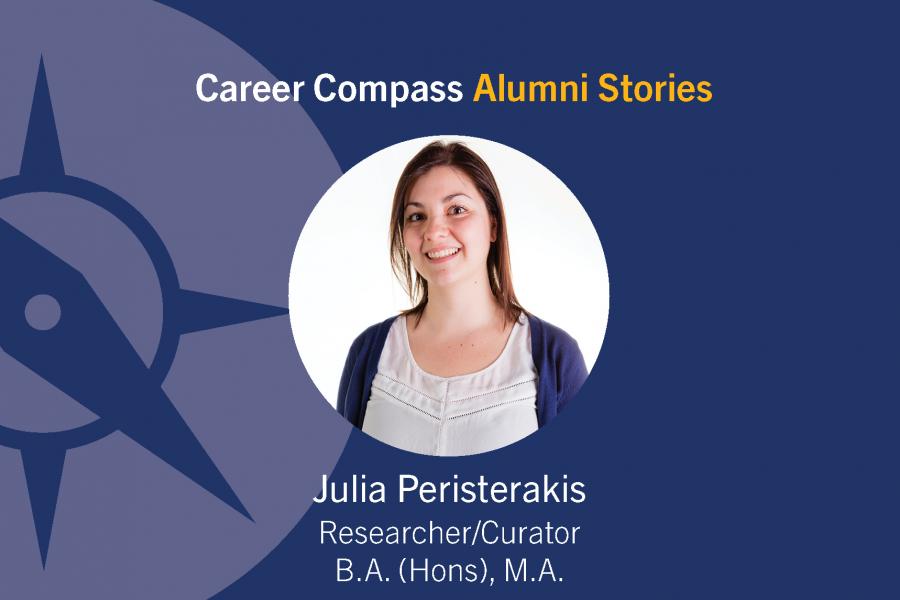
Career Compass Sociology Alumni Story: Julia Peristerakis, Researcher/Curator, B.A. (Hons), M.A.

Julia Peristerakis, B.A. (Hons), M.A.

Julia Peristerakis a researcher/curator at the Canadian Museum for Human Rights. Julia conducts in-depth human rights research to inform the content development of museum exhibitions.

Read more about Julia Peristerakis's career path

Briefly, tell us about your job. What do you find most rewarding? What are your greatest challenges within this profession?

I am a researcher/curator at the Canadian Museum for Human Rights. I conduct in-depth human rights research to inform the content development of museum exhibitions. It is very rewarding to see my research come to life through exhibits and to see visitors reacting and understanding human rights issues. There are many challenges involved in displaying and telling human rights stories, including working with communities that have been subjected to major rights violations. A large part of my work is to critically evaluate these considerations.

What experiences and activities helped you to map out your career pathway?

While studying the University of Manitoba, I had the opportunity to present at an international workshop on Indigenous rights in North America and meet other academics working in the same area. This really helped me to connect with the people who were working in the areas in which I wanted to work. I also had the opportunity to work as a research assistant during both my undergraduate degree and during my graduate program. This provided me with the skills and experience for my research assistant position at the Canadian Museum for Human Rights.

As a student, did you see yourself in your current career? What stayed the same and/or changed?

I have always enjoyed doing research and was drawn to human rights and social justice issues, but I never imagined that it would lead to a position in a museum. Research and community engagement is what I wanted to do in my career, however now I am able to publish and present my research and use it to create unique museum exhibitions.

What advice do you have for students who are interested in pursuing a degree in sociology?

Sociology is such a broad discipline that can be applicable in so many careers. Critical thinking and research skills are very transferable; I was surprised to discover how useful theses skills have been for different types of jobs and how they help me to understand social issues.

What job search advice do you have for students and recent graduates?

Winnipeg is a small city and therefore has great opportunities for networking. If you find someone working in the field you would like to be in, ask them out for a coffee and find out how they got there. Don’t feel limited in what you can do and be open to using your skills in an unconventional way. Seize opportunities while you’re in school to work on special research projects or attend and present at conferences.

Tell us a fun fact about your career path.

I wrote my entire thesis while working full time as a research assistant at the Canadian Museum for Human Rights and while this was a particular challenge, it demonstrates the need to be adaptable and willingness to be open to opportunity when it knocks!

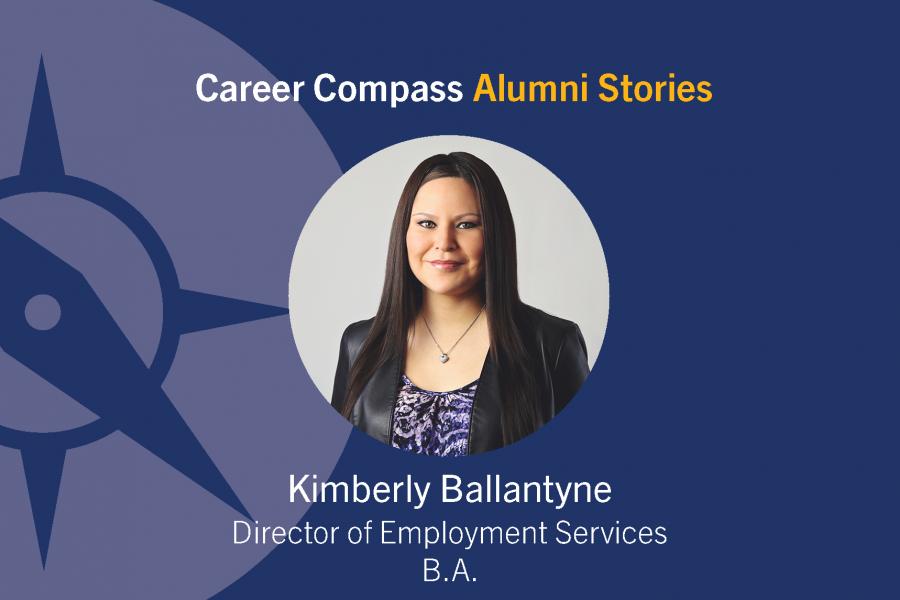
Career Compass Sociology Alumni Story: Kimberly Ballantyne, Director of Employment Services, B.A.

Kimberly Ballantyne, B.A.

Kimberly Ballantyne is the director of employment services for Centre for Aboriginal Human Resource Development (CAHRD) where she leads a team of twelve employment counsellors and support staff who provide dedicated career advice, coaching and recruitment services to Winnipeg’s urban Aboriginal population.

Read more about Kimberly Ballantyne's career path

Briefly, tell us about your job. What do you find most rewarding?

Centre for Aboriginal Human Resource Development (CAHRD) is an Aboriginal-led, charitable organization serving the urban Aboriginal community of Winnipeg. It offers a number of services including literacy, education, post-secondary training and employment counselling. We provide personal and academic supports to assist clients with the opportunity for growth, development and success. I am the director of employment services for CAHRD and lead a team of twelve employment counsellors and support staff who provide dedicated career advice, coaching and recruitment services to Winnipeg’s urban Aboriginal population. What is unique about our organization is that all the supports our clients need are under one roof. The thing I find most rewarding about my job is helping the Aboriginal community find employment, education or training.

What are your greatest challenges within this profession?

CAHRD understands that the Aboriginal community faces different challenges than the non-Aboriginal community. It recognizes and understands that our community faces multiple barriers such as a lack of education and training, affordable housing, and social supports such as daycare. Despite these challenges, we work as a team to help those who walk through our doors achieve their short and long term goals.

What experiences and activities helped you to map out your career pathway?

I am from The Pas, Manitoba and I was raised by my grandparents, Flora and Malcolm Crane, who taught me the value of education. In 1999, my high school hosted a career fair. I was drawn to the University of Manitoba booth and spoke with recruiters who informed about the different program offerings. It was then that I knew that I was going to attend this school. Ten years later, I moved to Winnipeg to attend university. It was the hardest but most rewarding goal I had accomplished up until that point. After completing my degree, I first came to CAHRD as a client and a position for an employment counsellor came available. I applied with the help of my counsellor and got the job. Five months later, I was asked to apply for the director of employment services position. I am amazed with all that I have accomplished in such a short amount of time and owe my success to my positive attitude and education. I’m so thankful for all the support I had along the way from my family, friends and CAHRD.

As a student, did you see yourself in your current career? What stayed the same and/or changed?

No, but I always knew I wanted to help my Aboriginal community. While attending university, I actually changed my major three times before I decided on sociology. Once I choose my major, everything fell into place. It was very stressful at times and was hard to juggle everything at once, but I knew that getting an education was something I really wanted. I am so thankful for the career path that I have chosen and where I am right now.

What advice do you have for students who are interested in pursuing a degree in sociology?

My advice to students interested in pursuing a degree in sociology is to never give up, stay focused and ask for help when you don’t understand something. Be organized, take lots of notes and use your quizzes to prep for exams, they do help a lot.

What job search advice do you have for students and recent graduates?

For non-Aboriginal students, there are a number of places you can go for assistance with your job search. Go to Career Services for help with your cover letters, resume and interview skills. Learn to network when you are job searching, post on social media and look at job websites. If you are Aboriginal, come to CAHRD and register with employment services. We are located at 304-181 Higgins Avenue. You can also call us at (204) 989-7117.

Tell us a fun fact about your career path.

If I had not chosen my career path I would not have met my partner Emil. We now have a beautiful three year old daughter named Nova and a son due in April who we have named Leo. I feel very blessed and thankful and would not change single thing.


Career Compass Sociology Alumni Story: Michael Dyck, Criminal Defence Lawyer, B.A., J.D.

Michael Dyck, B.A., J.D.

Michael Dyck is a criminal defence lawyer in Winnipeg. Michael provides legal advice to clients, negotiates with crown attorneys, and advocates for his clients in court.

Read more about Michael Dyck's career path

Briefly, tell us about your job. What do you find most rewarding? What are your greatest challenges within this profession?

I am a criminal defence lawyer in Winnipeg. I provide legal advice to clients, negotiate with crown attorneys and advocate for my clients in court. From first court appearances, to guilty pleas and sentencing hearings, to trials, it is rare that two days are ever the same. I love the challenges of thinking quickly and creatively to be persuasive. I enjoy the connection I have with clients and colleagues as well as the business/entrepreneurial side that I get to focus on because I work at a private firm. Advertising and business development are things I turned out to really enjoy and I have spent countless hours working on and adding content to my website. Some of challenges I face include ethical issues that arise almost daily and ensuring that I am providing the best legal services for my clients.

What experiences and activities helped you to map out your career pathway?

I wanted to be a lawyer while I was in junior high school. I attended the Mini University program at the University of Winnipeg and took a criminology course. I thought it was very interesting and that my somewhat argumentative nature and quick thinking would help me become a great lawyer.

As a student, did you see yourself in your current career? What stayed the same and/or changed?

When I first arrived at the University of Manitoba, I knew I wanted to pursue a law degree and my focus did not waver. In law school, I toyed with the idea of working in corporate/commercial law. However, my personality suited better to courtroom work so I ultimately focused on criminal law.

What advice do you have for students who are interested in pursuing a degree in law?

First, you have to be prepared to take on a significant amount of student debt that you will slowly pay off over the early years of your career. Second, a law degree is not a licence to print money. There are many lawyers who are unsuccessful. I think it is important that you enjoy the day to day work because otherwise you will not be motivated to work hard. Third, lawyers are respected and having a law degree can open a lot of doors, especially in politics. Finally, there are many different areas of law that fit many different personality types. Not everyone is going to be a courtroom lawyer and not everyone is going to love researching issues in estate law.

What job search advice do you have for students and recent graduates?

Searching for jobs as a lawyer can be difficult. My best advice is to connect with former classmates and talk to them about opportunities that they may know of. If you know lawyers that have been practicing for a few years, talk to them and see what they recommend.

Tell us a fun fact about your career path.

Most people do not associate the word fun with lawyer. I suppose a fun fact is that as a lawyer you will find an almost immediate dislike of all lawyer jokes and that most new people that you meet are incredibly keen to tell you the most recent one they heard. If someone starts talking about what to do with a lawyer buried up to his neck in sand, it is probably best to just walk away.

Campus resources and supports

Get one-on-one help

  • Meet with a career consultant

    Meet with a career consultant for a confidential discussion about your career goals, job search, resumé/CV and interview preparation.

    Contact Career Services at cs.receptionist@umanitoba.ca or call 204-474-9456 to make an appointment.

  • Talk to an academic advisor

    Talk to an academic advisor who will guide you to resources to help you make important decisions for your future. Advisors are specialized, often by program, faculty/school or unit.

    Find your advisor

Continue exploring

Select a Career Compass

Use Career Compass as a guide to develop a strong connection between your studies and your occupational choices. It will provide you with suggestions for academic and career planning specific to your program.

Advisors and Educators Guide

Information for career counsellors

Contact us

Connect with the faculty

Department of Sociology and Criminology, Faculty of Arts
318 Isbister Building
183 Dafoe Road
University of Manitoba (Fort Garry campus)
Winnipeg, MB R3T 2N2 Canada

204-474-9260

Connect with Career Services

Career Services
Room 474 UMSU University Centre
65 Chancellor's Circle
University of Manitoba
Winnipeg, MB R3T 2N2 Canada

204-474-9456
204-474-7516
Monday to Friday, 9:00 a.m. to 4:00 p.m.