Get the information you need for academic planning and connect with experiences to develop the knowledge, skills and attributes that employers are seeking.

This resource is meant as a guide to provide suggestions throughout your time at university (refer to the Academic Calendar for a complete list of program requirements). Develop a plan and timeline that suits you best. Make intentional choices for your courses and work experiences.

  • Student spotlight

    “The absolute best advice I could give is to get lab experience as early as possible! Apply for summer grants and talk to professors about undergraduate research. It teaches you so  much, allows for great networking opportunities and can actually be a lot of fun.”

    Teassa MacMartin, biological sciences co-op student

Life Sciences at UM

As a life sciences student at the University of Manitoba, you will learn about the structure and function of living organisms. The Faculty of Science has many opportunities for you to explore with four main areas of study in the life sciences:

  1. Biochemistry: the study of the chemical compositions, reactions and energy conversions of living systems. (see the Chemistry compass for additional Biochemistry resources)
  2. Biological Sciences: the study of life, from molecular processes inside cells to large scale interactions between organisms in their environment.
  3. Genetics: the science of heredity which deals with the mechanisms of inheritance.
  4. Microbiology: the study of the structure and function of microscopic organisms: bacteria, viruses, fungi and protozoa.

Skills you will gain by studying LIFE SCIENCES

  • The ability to safely operate complex equipment and follow technical manuals
  • The ability to collect, analyze and interpret data using statistical analysis and make reasoned judgements on the basis of the available data
  • The ability to apply scientific knowledge to analyze real-world issues in the various fields of study
  • The ability to think critically and develop a systematic approach to solve complex problems
  • The ability to communicate effectively both verbally and in writing

Academic Success

Year 1 - 30 credit hours


Course requirementsBIOL 1020 and BIOL 1030, CHEM 1100, CHEM 1110, and CHEM 1120MBIO 1010, plus additional course requirements for your major

To do this year:

  1. Know the requirements for your degree. Meet with an academic advisor in the Faculty of Science to help you plan your program.
  2. Use UM Achieve by running "what-ifs" to explore different program options & corresponding requirements.
  3. If you need academic support, visit the Academic Learning Centre for workshops or to meet with a learning skills instructor.

Year 2 - 60 Credit Hours


Course requirements: Refer to the Academic Calendar for course requirements in your honours or major program

To do this year:

  1. Meet with a department and science advisor to declare your honours or major program.
  2. Use UM Achieve to prepare a plan for registration.
  3. Considering a professional program? Refer to the Admission Office's Applicant Information Bulletin to familiarize with the pre-professional requirements.
  4. Consider taking a minor and choose courses that will open opportunities.

Year 3 - 90 Credit Hours


Course requirements: Refer to the Academic Calendar for course requirements in your honours or major program

To do this year:

  1. Meet with your department advisor and science advisor if needed for honours or major program approval.
  2. Use UM Achieve to prepare a plan for registration.
  3. Meet with your co-op advisor (if applicable).

Year 4 - 120 Credit Hours


Course requirements: Please refer to the Academic Calendar for course requirements in your honours or major program

To do this year:

  1. Meet with your department advisor and science advisor if needed for honours or major program approval.
  2. Meet with your co-op advisor (if applicable).
  3. Use UM Achieve to check eligibility to graduate.
  4. Confirm eligibility to graduate with a science advisor and declare intent to graduate in Aurora.

Career Tips

Year 1 - 30 credit hours


Start planning your career:

  1. Meet with a career consultant to generate career ideas based on your interests, values, personality and skills.
  2. Research occupations that match your skills and interests.
  3. Set up a UM Connect account to view job postings and register for workshops and events.
  4. Set up your Experience Record, an official record of university-approved activities.

Year 2 - 60 Credit Hours


Make professional connections:

  1. Join the Career Mentor Program to learn from professionals.
  2. Attend career fairs to connect with employers.
  3. Become a student affiliate with the Bioscience Association Manitoba.
  4. Use UM Achieve to prepare a plan for registration.
  5. Develop professional connections with professors by applying for an Undergraduate Research Award.

Market your skills: Develop your resumé and cover letter and refine your interview skills.

Year 3 - 90 Credit Hours


Investigate your career options:

  1. Look at sample job postings to ensure you have the qualifications upon graduation.
  2. Develop employability and essential skills sought by employers.
  3. Explore supports available to entrepreneurs for business planning including the Stu Clarke Centre for EntrepreneurshipWorld Trade Centre Winnipeg, and the Manitoba Government.
  4. Create a LinkedIn profile to network with professionals.

Consider continuing your studies: Check out the Faculty of Graduate StudiesExtended Education or other professional programs.

Year 4 - 120 Credit Hours


Start job search 9 months in advance: Contact Career Services to refine your job search and self-marketing strategies. You can visit the office up to 6 months after graduation.

If you are continuing on to a professional program or graduate school: Finalize your application materials and required tests. Use the awards database to search for funding and awards to help finance your continuing education. Contact your department to find out how their awards deadlines are advertised.

Volunteer & Work Experience

Year 1 - 30 credit hours


Link experiences to your career interests. Options include:

  1. Student groups including BUGS, Chem Club and Science Students’ Association.
  2. Volunteer for UM Orientation events to help welcome new students to campus while gaining experience.
  3. Student work opportunities including Work-StudySTEP Services or Federal Student Work Experience Program.
  4. Experiential education opportunities such as Community Engaged Learning programs and the Student Leadership Development Program.

Year 2 - 60 Credit Hours


Explore student research opportunities: Apply for a research assistant position, Undergraduate Research Award or NSERC grant.

Gain practical experience by volunteering: Check out Let’s Talk ScienceWinnipeg Regional Health Authority or environmental conservation and ecological organizations (e.g. Ducks Unlimited).

Earn while you learn: Consider applying to the Science Co-operative Education program once you have completed 60 credit hours.

Year 3 - 90 Credit Hours


Continue or start research: Participate in the Undergraduate Research Poster Competition.

Check out student job opportunities with: City of WinnipegFisheries and Oceans CanadaMini UOak Hammock MarshManitoba Government and WISE Kid-Netic Energy.

Search for job opportunities online: Check out Science.caBiotalentEco.ca or other search engines.

Use your networks and connections: Inquire about unadvertised job openings (the "hidden job market").

Year 4 - 120 Credit Hours


Ensure you have references in place: Ask your professor for a reference or a letter of recommendation if you're applying for graduate school.

Find opportunities to market yourself: Attend conferences and other networking events through Bioscience Association Manitoba (BAM).

Assess your resumé: Identify any gaps in experience and fill them through volunteering, work placements or internships such as the Science and Technology Internship Program.

Cultural Opportunities

Year 1 - 30 credit hours


Considering international opportunities? Check out the International Centre website to learn more international opportunities for UM students.

Explore communities and cultures you want to work with: Visit Migizii Agamik, the International Centre for Students or learn about local agencies via 211 Manitoba

Year 2 - 60 Credit Hours


Develop global career skills and expand intercultural learning: Consider an international student exchange, the Parks Canada Parks Life Program or the Wetland Ecology Field Course at Delta Waterfowl Station.

Staying local? Check out the Wildlife Project in Churchill or Community Engaged Learnin programs. Consider learning a new language and culture through the Language Partner Volunteer Program.

Year 3 - 90 Credit Hours


Did you travel abroad? Become an exchange mentor for the International Student Mentorship Program, join the exchange student community at the University of Manitoba or write an article about your experience.

Participate in the multicultural opportunities on campus: Participate in the Intercultural Development and Leadership Program or take part in the Graduation Pow Wow.

Year 4 - 120 Credit Hours


Prepare to work in a multicultural environment: Visit Canada's National Research Centre for Truth and Reconciliation on campus and register for the Intercultural Leaders program through the International Centre.

What do employers want?

Industries such as biotechnology, education, food and dairy, government, health and pharmaceutical development would value a life sciences degree in combination with the employability skills that are highly sought after by employers. These include:*

  • Oral and written communication
  • Numeracy and data use
  • Critical thinking
  • Problem solving
  • Teamwork
  • Digital technology
  • Industry specific knowledge
  • Continuous learning

Attain skills through your classroom education by taking advantage of experiential education opportunities.

*Information has been adapted from Employability Skills 2000+ and Workplace Education Manitoba – Essential Skills.

Alumni Stories

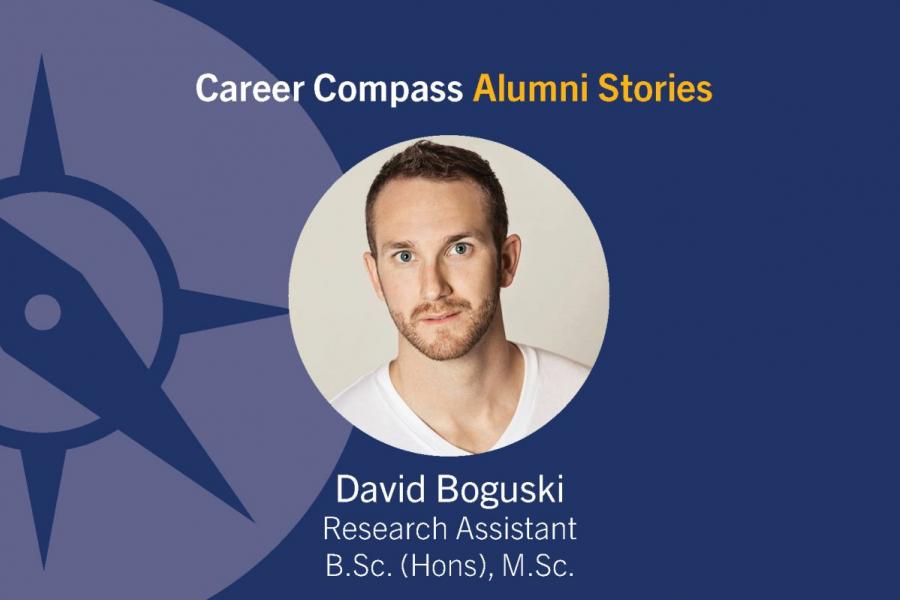
Career Compass Life Sciences Alumni Story: David Boguski, Research Assistant, B. Sc. (Hons), M. Sc.

David Boguski, B.Sc. (Hons), M.Sc.

David Boguski is a research assistant at the University of Manitoba in the department of biological sciences. His research explores the molecular genetics of mosquito sexual differentiation. David is also the founder of Biodive Scientific Inc., a company specializing in fisheries and aquatic science research.

Read more about David Boguski’s career path

Briefly, tell us about your job. What do you find most rewarding? What are your greatest challenges within this profession?

I am a research assistant at the University of Manitoba in the department of biological sciences. My research explores the molecular genetics of mosquito sexual differentiation. By identifying the genes involved in mosquito development, we can subsequently disrupt their expression and their products in an effort to control some of the most serious disease vectors. I am also the founder of Biodive Scientific Inc., a company specializing in fisheries and aquatic science research. I manage multidisciplinary fish-related programs ranging from single-unit assessments, such as species at risk, to large-scale biological surveys.

The technical advances in molecular biology yield tools that are often transferrable within the multi-faceted study of science. The most rewarding aspect of my career is the knowledge that the discoveries and advances I have made, or contributed to, in science, will supersede my time on earth – my career gives me a sense of purpose. I am rewarded each day knowing that I have the luxury of working in an environment that fosters creativity and exploration. The greatest challenge within this profession is the utility value of key science subjects relative to their difficulty. Constraints that accompany research such as limited time, resources, and knowledge of opportunities, make it challenging to acquire proficiencies. Basic research in Canada is not well funded and opportunities in science are highly competitive and often closely allied to industrial programs with an already saturated workforce. Accordingly, the over-abundance of highly qualified young researchers without jobs persists and these individuals often resort to short-term employment and/or contract work. A career in science requires flexibility, versatility and adaptability to meet market demand.

What experiences and activities helped you to map out your career pathway?

From an early age, I became fascinated with the natural world – always keen to catch insects, fishes, reptiles and amphibians. My respect for Mother Nature and passion for the outdoors was instilled in me by my parents who encouraged activities such as hunting, fishing, hiking, canoeing. I continued my pursuit of knowledge in natural systems throughout my undergraduate and graduate degrees where I would work tediously at the bench and in the field to delve more deeply into biology. My experiences travelling and working in Canada’s most remote and rugged regions, as well as the intellectual advances in biology, have helped shape my career pathway. From the start of the adventure up to the present, I have journeyed along the road of discovery.

As a student, did you see yourself in your current career? What stayed the same and/or changed?

Yes. I have always seen myself following a career in biology. Little has changed, in that, I find my work immensely rewarding and exciting.

What advice do you have for students who are interested in pursuing a degree in biological sciences?

It may sound cliché, but pursue your passion. I never find waking up in the morning difficult knowing that I am doing something that I love. Developing your skills in science communication (writing, public speaking, leadership, project management and teaching) and building and maintaining a professional network will set you apart from your peers and allow you to excel along your career pathway.

What job search advice do you have for students and recent graduates?

First, establish what it is about science that most interests you and align your interests with those of other people who are currently working in that particular scientific field. Then, build your skill-set by networking, volunteering, taking courses, working over the summers. Also, take advantage of the Career Mentor Program. It is no longer practical to do only fieldwork as a career in biology, so if field studies are your passion, ensure you develop complementary skillsets. Do not be afraid to pick up the phone and ask for guidance. Remember, potential employers are looking for two key things: your competency in the position for that you are applying and your ability to work well with others. The key to job searching is perseverance.

Tell us a fun fact about your career path.

I have been fortunate enough to participate in multiple Canadian Arctic fisheries research programs. I have had no shortage of wonderful adventures and exposure to various cultures. One fun fact that comes to mind is that I have enjoyed many a night sleeping outside in a quinzhee or igloo. You would be surprised at how warm it is inside your shelter when it is so cold outside.

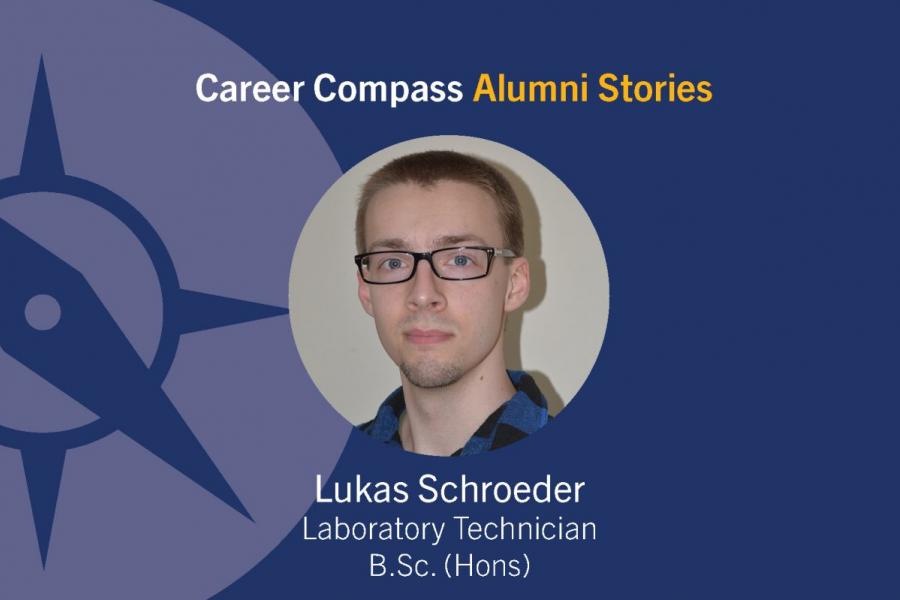
Career Compass Life Sciences Alumni Story: Lukas Schroeder, Laboratory Technician, B. Sc. (Hons)

Lukas Schroeder, B.Sc. (Hons)

Lukas Schroeder is a laboratory technician at JC Wilt Infectious Disease Research Centre. Lukas' research project is to screen samples for specific antibodies against human immunodeficiency virus (HIV) and their role in HIV infection.

Read more about Lukas Schroeder’s career path

Briefly, tell us about your job. What do you find most rewarding? What are your greatest challenges within this profession?

I am a laboratory technician at JC Wilt Infectious Disease Research Centre. My research project is to screen samples for specific antibodies against human immunodeficiency virus (HIV) and their role in HIV infection. I find it incredibly rewarding to be involved with research which could lead to new ways to help prevent and treat HIV. One of the challenges I have faced is learning how to analyze the data I have collected through my research.

What experiences and activities helped you to map out your career pathway?

One of the biggest factors that contributed to my career pathway was enrolling in the co-operative program for microbiology. It allowed me to gain invaluable working experience in different laboratories. In my final co-op work term I began the work that would eventually become my current research project today.

As a student, did you see yourself in your current career? What stayed the same and/or changed?

Even at a young age I had an immense interest in infectious diseases so I knew long before I became a university student what career I wanted to get into. Once I entered university I began working towards my microbiology degree right away. During my time at the University of Manitoba, the vision for my career remained the same and focused.

What advice do you have for students who are interested in pursuing a degree in microbiology?

Having a passion for learning new things is important in the area of microbiology. It moves rapidly with new discoveries, technology and newly emerging infections.

What job search advice do you have for students and recent graduates?

Having work experience in a laboratory is crucial. It is something that many employers are looking for. The best thing to do early on in your degree is speak to professors at the University of Manitoba about summer research opportunities. Then, build on those experiences with the co-operative program or honours research project.

Tell us a fun fact about your career path.

At a very young age I would attend open house events at the National Microbiology Laboratory (NML). I was able to meet and speak with many research scientists who worked there and asked them what qualities and experience they look for in new hires. I learned from them that the co-operative program was an excellent way to begin a career in the field of microbiology.

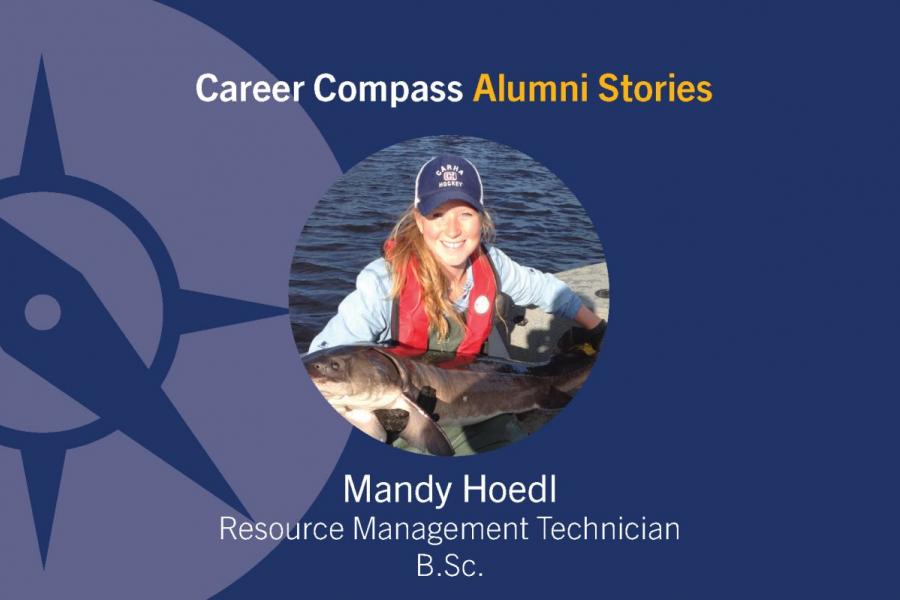
Career Compass Life Sciences Alumni Story: Mandy Hoedl, Resource Management Technician, B. Sc.

Mandy Hoedl, B.Sc.

Mandy Hoedl is a resource management technician with the Dryden District Ministry of Natural Resources and Forestry (MNRF). Mandy's mandate is to ensure the good stewardship and sustainability of our natural resources. In this position, Mandy plays a role in fish and wildlife monitoring and research of forestry planning, lands tenure and environmental compliance.

Read more about Mandy Hoedl's career path

Briefly, tell us about your job. What do you find most rewarding? What are your greatest challenges within this profession?

I am a resource management technician with the Dryden District Ministry of Natural Resources and Forestry (MNRF). My mandate is to ensure the good stewardship and sustainability of our natural resources. In this position, I play a role in fish and wildlife monitoring and research of forestry planning, lands tenure and environmental compliance. My job involves a lot of boots on the ground, eyes in the air and boats on the water fieldwork. Half the time my office is the beautiful wilderness of northwestern Ontario and that is the most rewarding part of my job. A big challenge I face in this profession is trying to preserve and protect our natural resources in an ever-changing environment. The MNRF as a whole needs to adapt with these changes and determine new and improved ways to maintain our mandate.

What experiences and activities helped you to map out your career pathway?

I’ve always enjoyed spending time outdoors and have never been afraid to get my hands dirty. I grew up on a farm with lots of animals and have always loved going camping, fishing, horseback riding and hiking. Science was always my favorite subject in school and it didn’t hurt that I excelled in biology and chemistry, which lead me to believe that a degree in science was my future.

As a student, did you see yourself in your current career? What stayed the same and/or changed?

All throughout high school and even into my first couple years of university I was dead set on becoming a veterinarian. I did a co-op work term at an animal clinic and even worked at one for several years. One summer, I decided to branch out and apply for a summer student position with the Ministry of Natural Resources (MNR). I gained a wide variety of experience in various areas and I began to realize how much I enjoyed the diversity of the MNR and not being stuck inside all day, every day. I didn’t abandon biology but simply moved in a different direction and so began my journey through the MNR. I bounced from contract to contract, working as a fisheries technician with the broad-scale monitoring program in the summer and an assistant fisheries aging technician at the regional aging lab in the winter before finally landing a permanent, full time position.

What advice do you have for students who are interested in pursuing a degree in biological sciences?

A Bachelor of Science degree is quite unique in that you can keep your studying broad or become very specialized. If you know science is the right path for you, then you’ve already made the most difficult choice. The wonderful thing about this degree is that whatever science-related career you choose, this degree will take you there and even if you change your end goal, this degree can still get you there!

What job search advice do you have for students and recent graduates?

You must be patient and very persistent when embarking on the search for a job because you cannot expect to jump right into your dream job immediately after graduation. You’ll find the career you’re looking for if you keep at it and, in the meantime, you may have to work a few odd-ball jobs because your student debt will be there waiting for you immediately after you graduate.

Tell us a fun fact about your career path.

I worked as a bank teller for 8 months post graduation before I landed my first contract as a fisheries technician. I went from formal business attire to fish covered rain gear in a matter of days!

Career Compass Life Sciences Alumni Story: William Watkins, Zoologist, B. Sc. (Hons), M. Sc.

William Watkins, B.Sc. (Hons), M.Sc.

William Watkins is a zoologist for the Manitoba government working in the biodiversity, habitat and endangered species section of the Wildlife and Fisheries Branch. William's activities focus on rare species and species at risk including bio-inventory, population monitoring, conservation status assessment, recovery and management planning and the development of policy and legislation.

Read more about William Watkins's career path

Briefly, tell us about your job. What do you find most rewarding? What are your greatest challenges within this profession?

I am a zoologist for the Manitoba government working in the biodiversity, habitat and endangered species section of the Wildlife and Fisheries Branch. My activities focus on rare species and species at risk including bio-inventory, population monitoring, conservation status assessment, recovery and management planning and the development of policy and legislation. My management projects have ranged from endangered prairie butterflies to polar bears. I am currently a member of the Committee on the Status of Endangered Wildlife in Canada (COSEWIC), the body which advises the federal Minister of the Environment on the listing of species under Canada’s national Species at Risk Act for protection. I also teach evening courses in biology and environmental studies at the University of Winnipeg.

I find working to preserve Manitoba’s biodiversity for future generations personally rewarding and I particularly enjoy being part of a group of people that bring a high level of passion and dedication to their work. One of my greatest challenges is to identify potential funding partners and build effective cooperative partnerships for the management or recovery of species at risk. Another challenge is the diversity of the organisms that I work with. There is no one-size-fits-all solution for the recovery of endangered species and I find that I must be a perpetual student learning as much as I can about each new species or group of species that I work on to develop conservation strategies.

What experiences and activities helped you to map out your career pathway?

I grew up in a family that instilled a love of nature in me and fostered an inquisitive outlook towards the natural world. When I entered university I was looking for a career in science that had an outdoor component to it. I had enjoyed biology in high school and at the end of my first year at the University of Manitoba I accepted an invitation into the zoology honours program. My first career-oriented summer job with the Canadian Wildlife Service was important in affirming my decision to become a biologist and in sparking an interest in working for government. My professors in my senior year as an undergraduate were instrumental in helping me decide to enter graduate studies after my first degree. I completed a master of science at the University of Manitoba that was primarily lab-based and applied to enter a doctoral program in eco-physiology at the University of Alberta. I left the program before completing it to accept a position with Manitoba Conservation and Water Stewardship where I have worked for over 30 years.

As a student, did you see yourself in your current career? What stayed the same and/or changed?

As a student I initially saw myself having an academic career in the sciences. My first career-oriented summer job was in government and made me realize that options other than academia existed. I am currently in a position doing exactly what I had hoped to do after graduation. However, it took a number of years working in several related but different positions before I moved into my present position. Each one of them taught me important skills that I currently apply in my work.

What advice do you have for students who are interested in pursuing a degree in biological sciences?

Life experience and practical skills are often as important as coursework and good grades for a career in wildlife biology. While at university, take every opportunity to develop outdoor skills such as camping and canoeing. Species identification is critically important to a field biologist and it isn’t usually taught in the classroom, so begin learning to identify the common birds, mammals, fish, plants and insects in your area and keep working at it until you feel confident in your identification skills. Develop the life-long habit of reading every day and read material related in the broadest sense to your chosen career.

What job search advice do you have for students and recent graduates?

Network! Join organizations related to your career and attend events to meet people. Ask them to send employment bulletins to you. There may be positions available that are not posted on the employment bulletin boards or sources that you routinely search. Look for consulting firms, government departments and non-government agencies that you might like to work for and email your resumé and cover letter to an appropriate manager. Follow up on a regular basis to inquire about employment opportunities. Find volunteer opportunities to develop new skills and build your resumé. Think about related positions that might require the core analytical, integrative and communication skills that you developed in your degree program and be open to new experiences and opportunities.

Tell us a fun fact about your career path.

I once had lunch with Canada’s Governor General as part of a team invited to discuss polar bear conservation and the role of Winnipeg’s International Polar Bear Conservation Centre in research, conservation and public education. During my career I have had the opportunity of meeting many interesting people from First Nation elders to distinguished scientists, environmental crusaders, authors, photographers and politicians.

Campus resources and supports

Get one-on-one help

  • Meet with a career consultant

    Meet with a career consultant for a confidential discussion about your career goals, job search, resumé/CV and interview preparation.

    Contact Career Services at cs.receptionist@umanitoba.ca or call 204-474-9456 to make an appointment.

  • Talk to an academic advisor

    Talk to an academic advisor who will guide you to resources to help you make important decisions for your future. Advisors are specialized, often by program, faculty/school or unit.

    Find your advisor

Continue exploring

Select a Career Compass

Use Career Compass as a guide to develop a strong connection between your studies and your occupational choices. It will provide you with suggestions for academic and career planning specific to your program.

Advisors and Educators Guide

Contact us

For help seeking advice and information, please visit the Faculty of Science Academic Advising page.

Connect with the faculty

Faculty of Science
230 Machray Hall
186 Dysart Rd
University of Manitoba (Fort Garry campus)
Winnipeg, MB R3T 2N2 Canada

204-474-8256
Our office is open Mon - Fri, 8:30 am to 4:30pm

Connect with Career Services

Career Services
Room 474 UMSU University Centre
65 Chancellor's Circle
University of Manitoba
Winnipeg, MB R3T 2N2 Canada

204-474-9456
204-474-7516
Monday to Friday, 9:00 a.m. to 4:00 p.m.