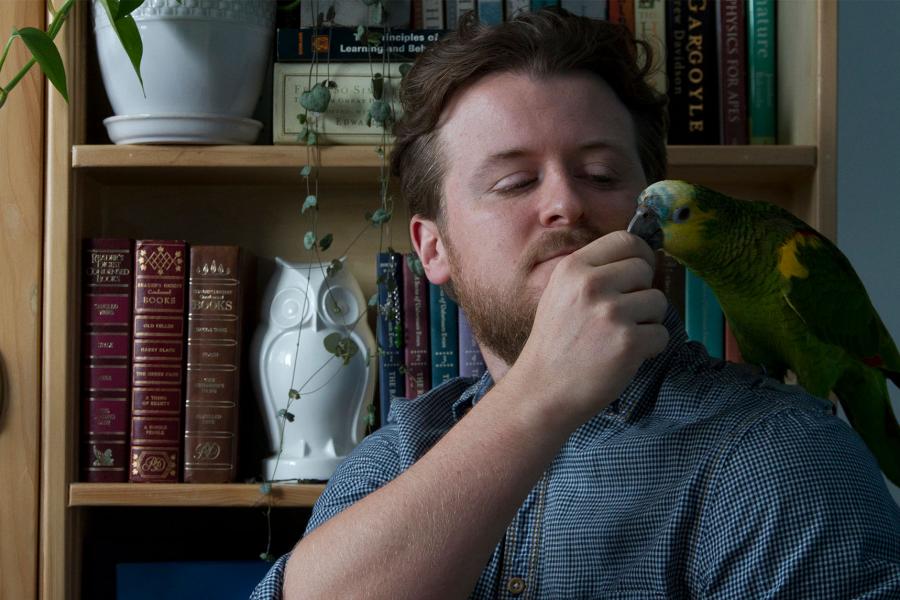
• A headshot of dawsonclary
  • Instructor

    Faculty of Arts
    Department of Psychology
    P517B Duff Roblin Building
    190 Dysart Rd
    University of Manitoba
    Winnipeg, MB R3T 2N2

    dawson.clary@umanitoba.ca

    Preferred pronouns: he/him

Currently accepting graduate students - no


Teaching

  • Psyc 1200 - Introduction to Psychology

Biography

Like many, I was drawn to psychology out of a desire to understand what makes us unique. This interest led me to studying psychology through the lens of comparative cognition - the comparison of species to understand how brains and behaviour have evolved. In my research, I investigated whether corvids (large-brained birds in the crow family) are capable of feats such as mirror self-recognition and perspective taking, abilities commonly only ascribed to humans.

In my current teaching position, I administer the Introduction to Psychology program for the Department of Psychology. In this role, I use my overlapping expertise in biology and psychology to broaden the perspectives of my students who may otherwise only think about psychology from a human-centric perspective. I endeavour to continually refine my teaching and learn new pedagogical approaches, so I can best prepare my students for wherever their academic journey takes them.

Education

  • PhD (Brain and Cognitive Sciences), University of Manitoba, 2016
  • MA (Brain and Cognitive Sciences), University of Manitoba, 2012
  • BSc (Psychology), University of Alberta, 2008

Selected publications

  • Vernouillet, A., Clary, D., & Kelly, D.M. (2022). Social information used to elicit cache protection differs between pinyon jays and Clark’s nutcrackers. Behavioral Ecology and Sociobiology, 77, 50. doi: 10.1007/s00265-023-03307-9
  • Clary, D., Stow, M., Vernouillet, A., & Kelly, D.M. (2020). Mirror-mediated responses of California scrub jays during a caching task and the mark test. Ethology, 126, 140-152. doi: 10.1111/eth.12954 (Invited submission to special issue).
  • Clary, D., & Kelly, D.M. (2016a). Clark’s nutcrackers (Nucifraga columbiana) flexibly adapt caching behaviour to a cooperative context. Frontiers in Psychology, 7, 1643. doi:10.3389/fpsyg.2016.01643
  • Clary, D., & Kelly, D.M. (2016b). Graded mirror self-recognition by Clark’s nutcrackers. Scientific Reports, 6, 36459. doi: 10.1038/srep36459
  • Vernouillet, A., Anderson, J., Clary, D., & Kelly, D.M. (2016). Inhibition in Clark’s nutcrackers (Nucifraga columbiana): results of a detour-reaching test. Animal Cognition, 19, 661-665. doi: 10.1007/s10071-016-0952-y
  • Clary, D., Skyner, L.J., Ryan, C.P., Gardiner, L.E., Anderson, W.G. & Hare, J.F. (2014). Shyness-boldness, but not exploration, predicts glucocorticoid stress response in Richardson’s ground squirrels (Urocitellus richardsonii). Ethology, 120, 1101-1109. doi: 10.1111/eth.12283
  • Clary, D., Cheys, A. & Kelly, D.M. (2014). Pattern of visuospatial lateralization in two corvid species, black-billed magpies and Clark’s nutcrackers. Behavioural Processes, 107, 94-98. doi: 10.1016/j.beproc.2014.07.020
  • Clary, D., & Kelly, D.M. (2013). Are Clark’s nutcrackers (Nucifraga columbiana) able to discriminate knowledge states of human experimenters during an object-choice task? Evolutionary Psychology, 11, 628-646. doi: 10.1177/147470491301100310
  • Clary, D., & Kelly, D.M. (2011). Cache protection strategies of a non-social food-caching corvid, Clark’s nutcracker (Nucifraga columbiana). Animal Cognition, doi: 10.1007/s10071-011-0408-3

You may also be interested in