Mind the Design: Contemplative Approaches to Interior Environments
Instructor: Kurt Espersen-Peters
ARCG 7102
3 credit hours
The University of Manitoba campuses and research spaces are located on original lands of Anishinaabeg, Ininiwak, Anisininewuk, Dakota Oyate, Dene and Inuit, and on the National Homeland of the Red River Métis. More
University of Manitoba
Winnipeg, Manitoba Canada, R3T 2N2
Below is a list of Faculty of Architecture Courses that will be open for registration starting March 23, 2026.
The Faculty of Architecture at the University of Manitoba will be offering the following online distant education 1000 level Environmental Design courses during 2026 Summer Term.
If you have any questions about these courses or the Environmental Design Program please email env.design@umanitoba.ca
Instructor: Kurt Espersen-Peters
ARCG 7102
3 credit hours
Are there such things as mindful spaces or only spaces created by mindful designers? This studio course explores this question through the many aspects of contemplative design. By revisiting the role of the designer in the design process, this course tackles a range of design interventions at various scales that investigate how we conceptualize and create our interior environments. The course strikes a balance between history, theory, critical thinking and design, critiquing existing design practices while exploring alternate design methodologies and approaches.
Instructor: TBD
ARCG 7080
3 credit hours
Instructor:
Price Faculty of Engineering:
Kathryn Atamanchuck
Kari Zacharias
Faculty of Architecture:
Shawn Bailey
Liane Veness
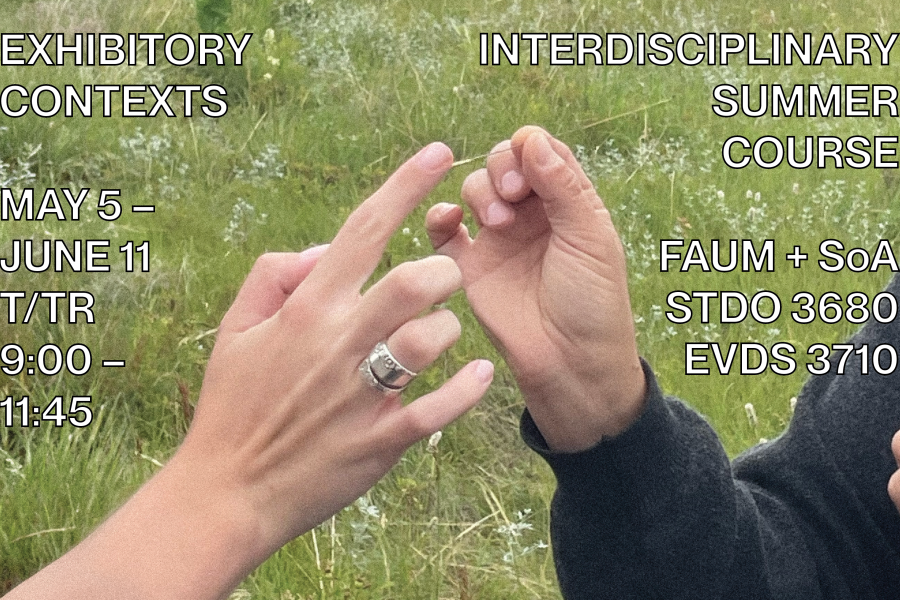
EVDS 3710 & ENG 4100
May 4 to May 28
Mondays and Thursdays, 10:00 am - 4:00 pm
June 1 to June 12
Monday to Friday, 10:00 am - 4:00 pm
An Offering is a collective, land-based design-build journey inspired by the Travesía at Open City Chile; where architecture and engineering come together as an unfolding event rather than a fixed object. Developed in partnership with Makate Waagamichiwanang Gakinaa’amaatiwin Youth & Family Wellness Camp, a land-based cultural and healing site grounded in Anishinaabe knowledge, the studio engages directly with community, Elders, youth, and knowledge keepers. Working across disciplines, students will move between observation, analysis, drawing, prototyping, and construction; testing ideas through material, structure, and poetics. Through immersion on site, learning happens through doing: drawing, cooking, building, measuring, and gathering. Central to this work is food sovereignty; the understanding that food systems are inseparable from land, infrastructure, and the relationship between environment, body, and community. Grounded in seven-generational thinking, the studio frames making as an act of offering - to the land, to community, and to those who follow. The outcome will be a real, constructed intervention (potentially temporary or evolving) but grounded in care, collaboration, and shared responsibility, positioning design and engineering as relational, embodied, and lived practices.
Instructor: TBD
EVDS 3710
3 credit hours
Instructor: Heather Anderson
ARCG 7080
May 5 - June 11, 2026
Tuesdays and Thursdays, 9:00 am - 12:30 pm
3 credit hours
This course provides an in-depth exploration of professional interior design practice, bridging academic learning with real-world application. Led by a Professional Interior Designer, students will engage in the early stages of a live project, gaining hands-on experience with client meetings, programming, teamwork, budgeting, and standard documentation.
Through a combination of lectures, discussions, and practical exercises, students will refine their skills in space planning, design development, and the selection and specification of furnishings, materials, and finishes—considering critical factors such as functionality, ergonomics, sustainability, life safety, and lifecycle impact. The course also emphasizes client communication, contract documents, and the designer’s broader responsibility in shaping human well-being.
By the end of the course, students will not only build confidence in professional design processes but also develop a deeper appreciation for lifelong learning and public service in interior design.