
Gallery One One One is pleased to announce 27 x Doug: Portraits by Larry Glawson, an exhibition that will showcase selections from his various bodies of work, including Family Album (1983), Private Icons (1986), The Self Portrait Project (1988), Paired Portraits (1992), The Anonymous Gay & Lesbian Portrait Project (1992-2005), and his most recent series, home bodies (2002-ongoing). ). The curator has chosen to represent this thirty-year survey by exclusively dealing with portraits of the artist's partner, Doug Melnyk. McFadden's approach has been appropriated from a previous exhibition at The University of Winnipeg's Gallery 1C03, titled 27 X Sonia: Portraits by Walter Grammate (curated by Sarah McKinnon in 1992), and is explicit in its queer revisioning of history. Included here will be a range of black and white photographs, large-scale c-prints, digital prints as well as a video projection all of which illustrate Glawson's interest in the relationship between the mundane and the sublime, the quotidian and the detailed qualities of a life of work and love.
Larry Glawson is one of Manitoba's pre-eminent photographic and digital artists, and has been an active member of Winnipeg's artist-run scene for more than twenty-five years. He was a founding member of aceartinc as well as a long-standing member of The Winnipeg Photographer's Group and The Floating Gallery, which evolved into PLATFORM: centre for photographic + digital arts. Glawson has been involved with these organizations as both a member and staff person throughout the years. He has also been a professor of photography at the University of Manitoba's School of Art for over fifteen years: as a mentor he has influenced a generation of Winnipeg artists. Glawson received his BFA (Honours) in 1982 from the School of Art, University of Manitoba, followed by an MFA at The University of Western Ontario in 2002.
Guest-Curator J. J. Kegan McFadden is a Winnipeg-based cultural worker whose curatorial interests lay in the realms of feminist and queer perspectives in culture-production and knowledge dissemination, artists' books, and divergent photographic practices. McFadden holds a BA (Honours) in Art History from the University of Winnipeg (2005) and an MA in Art History / Critical and Curatorial Studies from the Department of Art History, Visual Art & Theory at the University of British Columbia (2007). He is currently the Director / Curator of PLATFORM centre for photographic + digital arts.
Gallery One One One gratefully acknowledges the support of The Canada Council for the Arts, The Manitoba Arts Council, School of Art staff and volunteers, Aston Coles, Richard Dyck, The Lab Works, Warehouse Artworks and lenders to the exhibition, Bev Pike, Dave Grywinski, The Winnipeg Art Gallery, and Kegan McFadden.
Events:
Closing Reception: Wednesday 15 September, 5–8 PM
Artist and Curator in Conversation: Wednesday 15 September, 7 PM
In the Press:
OVER AND OVER AND OVER AGAIN by J.J. Kegan McFadden, Curator
The exhibition 27 x Doug: Portraits by Larry Glawson pinpoints certain consistencies throughout the career of Winnipeg-based photographer and media artist Larry Glawson. Nearly thirty images produced over as many years are brought together for the first time so that formal, aesthetic, and conceptual links may be analyzed from one series to the next. The truest constant in all of Glawson’s series, apart from his ongoing concern regarding the relationship between photographer and subject, is the image of his partner (and some may say ‘muse’), the artist Doug Melnyk. In order to provide a thorough overview of Glawson’s career output, I wanted to focus solely on this constant – the image of Doug – over time. This strategy is blatantly appropriated from an exhibition, which took place at The University of Winnipeg’s Gallery 1C03, titled 27 X Sonia: Portraits by Walter Grammatté.1 Explicit in its queer re-visioning of history, this exhibition illustrates Glawson’s interest in the relationship between the mundane and the sublime, the quotidian and the detailed qualities of a life of work and love.
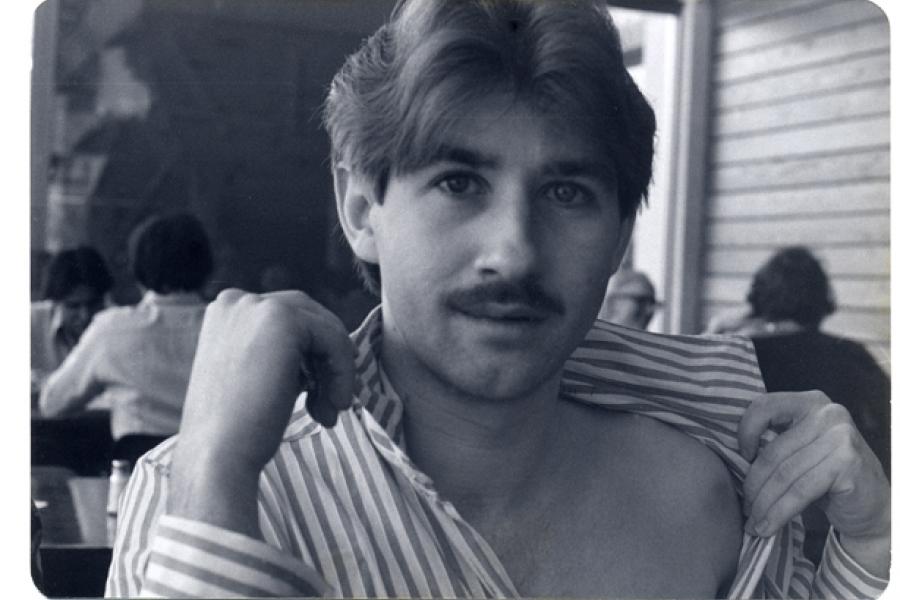
What is surprising is how the same subject, Doug, may be viewed in various ways from one series to the next. The first photograph Glawson ever took of Doug was in 1979, while the two young men were enrolled in the school of art at the University of Manitoba. In this 3.5” x 5” black and white snapshot, a confident and exuberant Doug pulls back the collar of his shirt to show off a hickey he’d recently received. This uncategorized and never before exhibited work acts as a precursor and foreshadows the numerous photo shoots Doug would sit through over the following thirty years, many underscored by sensuality and sexuality.
In Family Album (1982 / 1983), Glawson’s first body of work produced following his graduation from art school, we see Doug as contemplative but dreamy, a result of Glawson’s blurring of the lines between object and subject. Whether the backdrop is that of a cramped apartment with aquarium, or the spacious family cottage, Doug is pictured as aloof but gorgeous with various props (in this selection all having something to do with water): an aquarium, a swimming pool, and a wooded lakeshore. Included here is also the image of Doug with his Mother, Kully, on the dock at the cottage. A drizzly evening calling for the need of sweatshirts and raincoats acts as backdrop for the pair who face in different directions. A cropped version of this work was used for the author's photo on the jacket of his first trade publication, Naked Croquet, an excerpt from which is incorporated in the exhibition:
I found out that if things are just right, everything will go all black and white for you. If there's a big difference in temperature between indoors and outdoors. If you've just had a really big drink of water, and you're really craving salt. If there's a strong light right behind you just before you close your eyes after a long time, you might notice it. If it's late at night in the middle of a long, hot summer vacation, and you're really open-minded. If you're lucky, really lucky, it will happen. Everything will turn black and white for one instant when the two of you finally get together again. If you're lucky, you'll notice it. You'll be exhausted, and you'll feel kind of hollow somehow, but then at least you'll know what I meant all this time.2
The first in only two images included in 27 X Doug that show the couple together is from Family Album (Doug & Larry, wallpaper) from 1983. This black and white image captures a stressful moment following the application of wallpaper to their apartment’s living room. The busy floral pattern is matched by the photographer’s furrowed brow, Doug’s early ceramic artwork on the mantel behind them, and the couple’s first cat, John, on Doug’s lap.
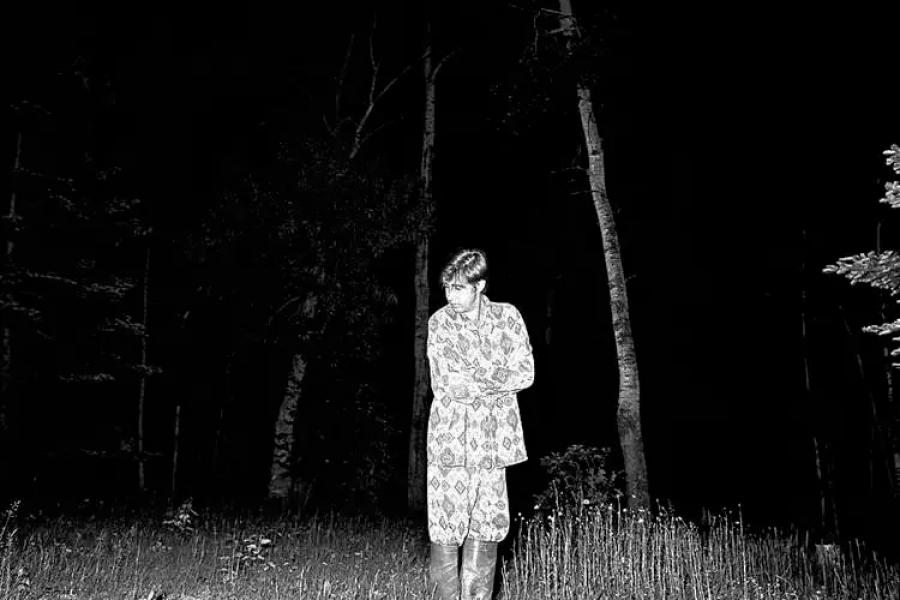
Private Icons (1984 / 1986) shows Doug in a more narrative-driven focus with allusions that may be read as symbolic in a Biblical sense, the plot to which is never fully disclosed to the audience. Here, Doug is shown on the road, shirtless and holding a multitude of objects: empty grape flavoured popsicle wrapper, a flower made of paper, his niece’s wood clogs, and a vintage dress shirt with his own embellishments drawn by hand onto the frayed and faded fabric. He looks to his left, and his body (half in frame), is practically dwarfed by the immense prairie sky. In a formal reversal of Doug on the road, is Doug off the dock (1985), where the subject dangles transcending a water, horizon, and sky lines, his sinewy and headless backside forming a sharp angle protruding out of frame but somehow anchoring the image. The third piece from this series pictures Doug in his father's bathrobe (1986), again at the cottage. The sentimentality offered in this image makes all the other pictures seem, in a way, less so.
Whereas in The Self Portrait Project, where individuals were instructed to take their own portraits, Doug was allowed to present himself as he saw fit. In this instance he dons the costume from the performance piece Gorilla,3 a collaborative project with Jack and Sheila Butler in the late-‘80s. Encumbered by this hairy vessel, Doug sits on the fire escape of the Larry's Winnipeg’s Exchange District studio. The gorilla head rests in one hand while he trips the camera’s shutter with the other. With this series Glawson asked his subject to choose the site; he would set up the lighting, adjust the camera’s exposure settings and leave the subject alone to trip the shutter themselves. This marks Glawson’s first forays into collaborative photographic work with his subject. Here Doug looks more perplexed than posed; a quality attuned with the intricacies of mechanical exploration (shooting rather than sitting, or more precisely -- shooting while sitting, for once). A compendium piece to this work included here is Doug in Edinburgh (1989) taken while in Scotland during the Edinburgh Fringe Theatre Festival where the collaborative team presented Gorilla as part Off the Beaten Track, a group exhibition jointly-produced by Ace Art Inc (Winnipeg) with Cooperative Gallery (Edinburgh) and Seagate Gallery (Dundee). In this photo, an exhausted-looking Doug has fallen into an armchair and becomes awash in patterns in order to perfectly encapsulate the feeling of being a performer on tour. This candid shot is rare in that Glawson often eschews documentary-style scenes, however it’s confusing patterning and beguiled Doug does ring true with images that would come later.
Paired Portraits (1989 – 1992) is the second instance in this grouping that shows the couple together in the frame – though the manner in which this portrait came about is a combination of two different shoots, the prints from which become manually overlaid once installed in order to bring together a scene which never truly existed. This false representation of a single moment is not unlike what photoshop hacks would spend time doing in years to come. For Glawson it points to a sensitivity to time and space, a concern with the limits of representation, and where portraiture can be further complicated. Here again we see Doug and one of his creations – another one of his hand-embellished vintage shirts with drawings of various naked creatures in blue ink all over the pink fabric. The technique of two separate sheets used for one single image predates Paired Portraits slightly and examples of those earlier experiments are included here in the diptych from 1988 where Doug is seen in both seated and standing positions. These uncategorized experiments were again taken at different times and pieced together purposely playing with the seam to offer a subtly fractured moment in time.
Following these early formal experiments with time and perception, Glawson moved on to further question the use of photography in portraiture and how representation is taken for granted but also how it may be returned to subject. Clearly a point the artist was making with his Self Portrait Project from the ‘80s, Glawson was able to revisit this idea with the Anonymous Gay and Lesbian Portrait Series (1992-2005). Doug makes two appearances in the Anonymous Gay & Lesbian Portrait Series, where he is initially shown as a shy but happy guy in front of his artwork - - a cluster of close-cut paper men stuck to the wall of the couple’s large shared studio space. Later on he reappears with a more impish expression on his face and a pet rat, Louise, on his shoulder. This series marks an important turn in Glawson’s output. Though he has been concerned with the power dynamics on portraiture since the beginning of his career, the A.G.L.P. series is the first in which Glawson experimented with post-production software such as Photoshop in order to superimpose faux framing devices as well as add backgrounds and other elements such as wording so that the subject’s identity, playing with possibilities of anonymity, may be hinted at visually or blatantly stated. Included along with these two images is Romantic Portrait #1 (1994). This colour portrait of Doug staring off into the blue sky, again likely lakeside, hints at daydreams and is among the first pieces digitally augmented by Glawson. It incorporates a sensuality not often seen in bodies of his work that may be attributed to the colour saturation and tonal adjustments. Though it plays an important part in Glawson’s development as a photographic and media artist, it is not part of any larger series and has not been exhibited until now.
Most recently Doug appears in home bodies, a series Glawson begun while completing his MFA at Western University in London, Ontario. In home bodies (2002 – ongoing), we see more intimate stills and video of Doug, taken from vantage points only a lover might be afforded. Included here is five examples taken from the series, including: Doug Sleeping (2002), trapdoor (2002), in bed (2003), licorice bouquet (2010), and the latest in the series, a full nude titled living room (2010). With home bodies Glawson implicates himself, his own image, more so than with any other preceding series in an attempt to explore constructs of visual representations of his personal domestic world. His latest portrait of Doug in the home bodies series is a classically-posed digitally stitched image which is also one of the first results of Glawson’s new interest in the abilities and limits of digital imaging post-production software and how it may be utilized to speak about failure in photographic representation. Its jagged lines and mashed up corner from several dozen images shot scan-style over the entire area where Doug posed adds up to a flattened image that veers in and out of focus.
When analyzing an artist’s career output certain notions about the work come to mind and constants over the span of that artist’s oeuvre begin to surface. Whether it is the choice of medium, subject matter, scale or concept – these are the elements that have always informed the artist’s practice. In Glawson’s case, his constants are equal parts the photographic medium and his lover/muse, Doug Melnyk. Also important to Glawson’s photo practice is his attitude towards portraiture. Since his first forays into portraiture in the early 1980s, Glawson has blurred the lines between photographer and subject by incorporating various personal ephemera of those posing for him, particularly Doug. More to the point, series such as Self Portraits Project, and Anonymous Gay and Lesbian Portraits skewer the subjectivity of a portrait and force questions around give and take, a levelling of the dynamic between subject and photographer.
- J.J. Kegan McFadden
NOTES:
1. Curated by Sarah McKinnon, 27 x Sonia: Portraits by Walter Grammatté (1897-1929) was exhibited at The University of Winnipeg’s Gallery 1C03 from January 16 to February 15, 1992. The reference to a past exhibition organized by Gallery 1C03 creates what I hope will be understood as an dialogue between the institutions and the community which it supports while at the same time queers the academic space once the history of Glawson’s relationship with Melnyk is made visible.
2. Doug Melnyk. "Black and White". Naked Croquet. Turnstone Press: Winnipeg, 1987.
3. As annotated in Live in the Centre: an incomplete and anecdotal history of Winnipeg performance art, edited / curated by Shawna Dempsey (WAG, 2004) “… Gorilla is performed again in Winnipeg in July 1989 at the Winnipeg Fringe [Theatre Festival] and on January 4th, 1990, at The WAG.” [p. 22]
EVERY DAY PERSON by Leah Sandals
National Post · Tuesday, Aug. 24, 2010
Family albums can be pretty public in the Facebook age. But few shooters have brought an art consciousness to the endeavour like Winnipeg photographer Larry Glawson--his quiet, everyday-relationship views have melded deep with domestic for 30 years. Now, with an unusual retrospective of his work on at Gallery One One One in Winnipeg, Glawson talks to Leah Sandals about companionship, cottages and unexpected commitment.
---
Q This exhibit features photos that you've taken of your partner, Doug, over 30 years. What was it like for you two to see this exhibition develop?
A It was an interesting process. The curator, J.J. Kegan McFadden, came up with the idea. He knew about a 1993 exhibition in Winnipeg that showed portraits Walter Gramatte did of his wife over a similar time period. So he proposed doing a retrospective of my work that way.
Getting to work with someone on a retrospective was a positive thing for me, and the idea of using Doug as the spine of the show was also interesting. He basically has been there since the beginning and has been involved with every body of work I've produced. For Doug, I think it was both flattering and daunting to have to see 30 years of photos of himself all in one space. I was a bit nervous about it, too.
Q So Doug didn't veto anything?
A No. I think Doug wanted to stay out of it, in a way. We have this sort of long-standing understanding that because of the kind of photographer that I am -- someone who focuses on the personal -- Doug is a 24/7 subject. This means I'm allowed to photograph him pretty much anytime I have an impulse to. There are images he's not particularly thrilled with, but what I do as an artist he respects. I'm very grateful he has that attitude.
Q How early in your relationship did you start photographing him?
A Well, the first photograph of him in this show, from 1979, was just a photo we took as students. We weren't a couple then; I'd just met him. But from immediately after that my whole career has been photographing people that I know -- family and friends. Being an artist himself, I guess he understood the priority photography took in my life. He was very generous that way.
Q Some people think of your work as being about gay culture. But looking at this show, it also seems a lot about cottage culture! Why are so many of these photos from the cottage?
A I guess that speaks to the larger position of my work as being about the personal and about my everyday world. I didn't go out to seek subject matter; my subject matter was what was around me. The cottage in these photographs is Doug's family's cottage, and my introduction to cottage life came through them.
Also, I do think the cottage, for me, was an exotic location; it wasn't part of my family growing up. I was fascinated with the way people behave at the cottage; there's this strange kind of leisure and work combination in the way that people are often in bathing suits and sitting around but always doing maintenance and building at the same time. And of course there's partying, too!
Throughout, a large part of my overall interest is in what things end up being when they are turned into a photograph, no matter what they are.
Q Nonetheless, people must go to this exhibit and wonder, "Wow, so what is it like to be part of a gay couple in Winnipeg for 30 years?" A lot has changed in that time period.
A Well, there are all these cliches -- the older you get, the faster time goes. Both Doug and I laugh about it, how fast 30 years can go by without realizing it. I think we've always lived in the present; we never had any sense of where we might be in five years, let alone 30. We were just living our lives in a way we felt was appropriate. My personality, his personality, how we were in the world together, it's just something that happened. We just liked being together -- and 30 years later, we're still here.