
Developed through an online exchange with Canadian artist Ken Lulevich, I Shot B..By (1999) originated from Shepley’s exploratory visit to Winnipeg during the 1998 Fringe Festival. Following this, Gallery 1.1.1. invited him to undertake a month-long installation in March 1999.
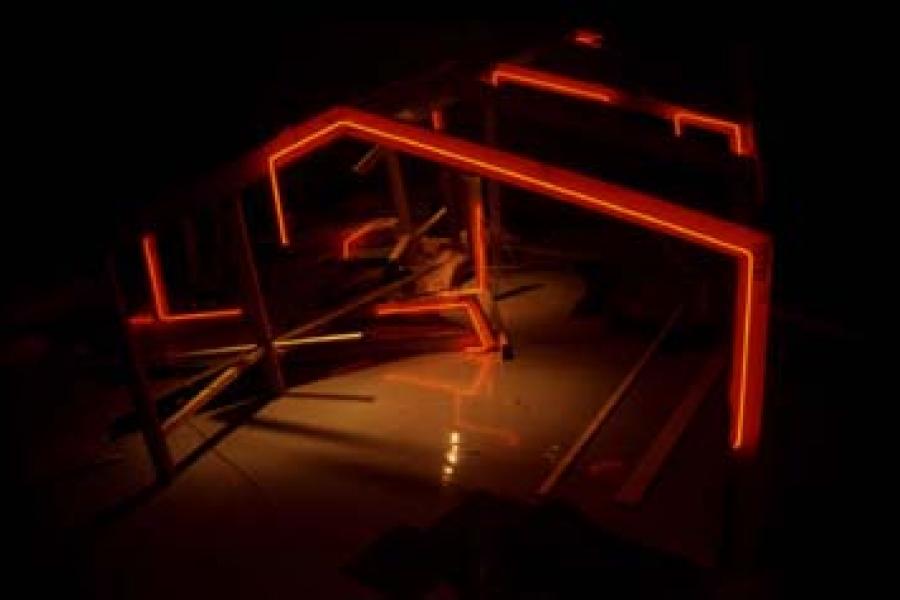
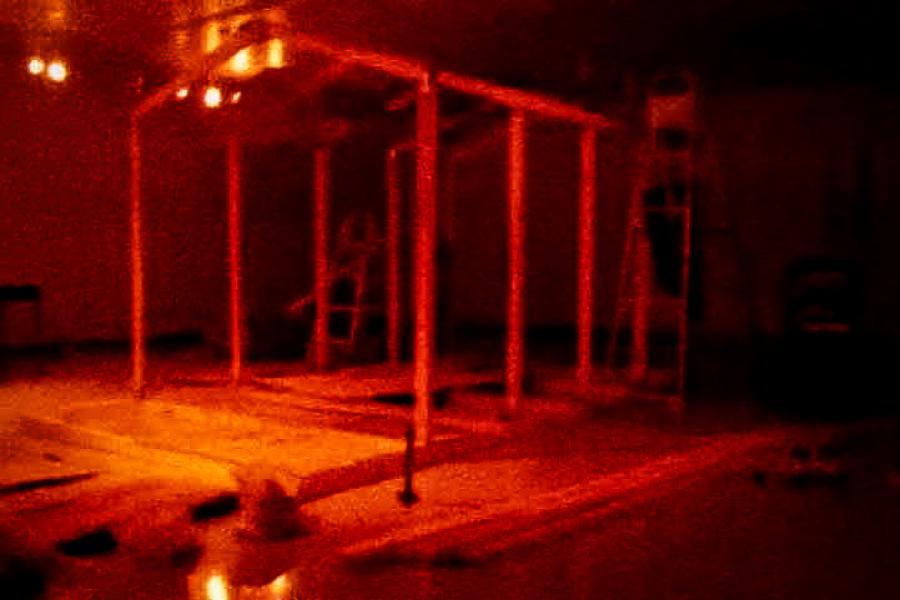
The project unfolded over three weeks as an evolving installation that blurred boundaries between process and final work. Shepley constructed a life-size, neon-lit, timber-framed structure resembling a collapsing house, incorporating materials such as shed kits, insulation, particleboard, and neon tubing. Miniature dioramas, sketches, and models—initially created in Shepley’s UK studio—served as entry points into the work, which constantly shifted throughout the exhibition.
Alec Shepley is an English artist who, at the time of his Gallery One One One exhibition, was a full-time lecturer in drawing at Edge Hill College in the UK. This interview with Cliff Eyland was conducted on the occasion of Shepley’s March 1999 exhibition at Gallery One One One, University of Manitoba, Winnipeg.
Interview with Curator Cliff Eyland and Alec Shepley (March 1999)
CE: "I Shot B..By" is the title of your Gallery One One One show, and an anagram of the word "hobbyist."
AS: I had a conversation with an English professor once who thought that there were about ten or so serious artists in the world and that the rest were just playing at it!
CE: What about your alter ego "Shelley Cape"?
AS: It's just a simple way of having a useful conversation with yourself.
CE: You do not have a studio, but prefer to work as what you call an 'itinerant' artist.Your Gallery One One One installation began when the exhibition opened, and you worked on it until the exhibition was over. Why do you work this way?
AS: I used to be a painter, and I painted myself into a cul-de-sac or a hole and I felt confined. I had what you might call a traditional studio practice in which I would use materials - canvas, linen, oil paint, various oil mediums, etc - very traditional materials. I wanted to master those materials and the traditional craft of painting. But when I was painting I began to feel held in a fixed position, a fixed viewpoint in relation to paintings and sculptural objects. The figure/ground tradition of painting became confining.
The more recent installation work became partly about problems of limitation or being confined by 'limits,' the limits of my earlier painting practice and the limits of the result.Painting did not reflect the complexity of what was going on in my head. It is exhilarating to use an entire space. There is an element of being caught in the prongs of a dilemma -- of being impaled on both horns of a dilemma -- in my installations, a falling short of a final solution that can be compromised by its 'closure.' The solution is in the feeling of exhilaration that comes just before 'the end' of an installation. I present models or scenarios of what I could build if I could - models that play with the idea of the frame.
CE: I understand that you also began to feel confined by your early commercial success as a painter, a success that included having a lot of exhibitions in the North-West (of England), in London and doing commissioned portraits.
AS: I was commercially successful but unsatisfied. The commercial success was not quite right - it seemed too much like a business. Besides, I was never happy with the idea of 'finishing' a painting.
CE: You were happy with your successes, but things were getting predictable.
AS: The practice didn't reflect the process enough. Rather, I wanted and still want the internal space of the art work to bleed into the space the viewer occupies. I felt extremely lonely in the studio, like I was cut off from the rest of the world. I felt that I was occupying this strange position of a person who stands on the bylines and then scurries off to his studio to produce work, showing it saying 'here, this is how I see you lot.' It seemed a bit arrogant and distant. Stuffy. It was not the way I wanted it to be. I wanted to get out and mix with people, to talk to people in my work rather than to simply show them what I'd done. To interact. So this idea of trying to make models of practice or scenarios of a practice is crucial because it represents the kind of process and relationship I am on about.
Hovering is very important. I'd always felt like I was hovering between painting and sculpture. Non-committal. Between real space and illusory space. As a student I always seemed to hover between painting and sculpture. I made painted constructions and assemblages, collages of found objects and of painted objects that were somewhere between painting and sculpture.
During the last five years I've made work that asks questions rather than provides answers. Earlier on I became increasingly unsure of my direction and I decided to make work that 'marked time.' It was like the opening up of a sluice gate. It all just came flooding out chaotically. As soon as I realised that I could make work that was unsure, vulnerable, and that 'hovered,' I was happy again.
CE: You use materials that are cheap, common, and everyday, often building materials, but these materials are also, since Cubism, common in the history of twentieth-century high art. What if your work starts to resemble Cubist collage, or Rauschenberg or Kurt Schwitters? What if your showing the 'process' creates 'arte povera ' icons that we have seen before?
AS: When I was an MA student, we read things that questioned the whole tradition and premises of Western art - authenticity, mastery, history - it set off fireworks in my head. I read other perspectives on painting. Feminist perspectives made me feel especially uncomfortable with this legacy. The more I read the more fragmented the 'history' I had learnt in my art education was becoming. It prompted doubts about my whole practice and a desire to do a demolition job using my old practice as the model for deconstruction. These doubts and unsure feelings became the focus of an installational practice.
I started to see my work as a space rather than an object, but I also want to represent the problem of trying to represent all this. If it started to look like something I didn't want, I'd burn it. I am trying to introduce elements of thinking and time into the work. I want to position things in real space and I want to involve real time.
Of course I've looked at people like Rauschenberg and Schwitters. I am concerned with occupying a border territory. (It seems ironic to use a military analogy like 'occupying a border territory.') The frame, or the rectangle that formed the edge of the painting seemed to me the most significant thing. The frame is neither the product nor the process, but the difference between the two. Lots of people are interested in that.
Donalda Johnson (Co-ordinator) on I Shot B-By (1999)
*"Opening day of this exhibition foretold the aesthetic experience to come. A small crate stood under a single overhead spotlight in the center of the gallery, and a tool cart waited expectantly to the side. Anticipation was 'building’' (pun intended!).
In the days that followed, a delivery arrived from McDiarmid Lumber that included a kit for a small shed, some sheets of particleboard, a batt of insulation, shingles, nails, etc.
Construction began immediately, but not in the usual sense of the word. The frame of the shed was raised but stretched forward for an expanded structure. Walls were partially covered with cut-out forms of particleboard, reminiscent of giant pieces of a child’s jigsaw puzzle. The board sheeting on the roof veered at strange angles, and light shone through the cut-out of a person in a spread-eagle pose (think Roadrunner cartoon). Small dioramas appeared in the gallery’s two windows onto the corridor. Bits and pieces of building materials, some in diminutive proportions, were scattered around and through the maquettes, whose themes suggested travel in a fragmented fashion—open skies, portions of roads, a doll-size suitcase clutched in the hand of a diminutive figure that bore a surprising resemblance to the artist.
Advance information preceding Shepley’s arrival indicated that he, as a 'lifelong and devoted assistant of internationally renowned artist Shelley Cape,' would 'reconstruct a diorama from her studio at home in England'—a station or landing place on her journey along and around Latitude 53 or thereabouts.
Each day, the work progressed, and the scene shifted as if one were viewing the space within a giant kaleidoscope. A table appeared in the pseudo-shed, and a miniature diorama blossomed. Resting on a lush green carpet, an upward-thrusting framework of balsa wood glowed in the overhead light… a construction nestled in another, a ‘birthing’ as it were.
Each of us has stopped to watch workmen at a construction site. Our curiosity is piqued by the noise, the anthill-like movement, and the sheer massiveness of the production. We are fascinated by the machinery, the bustle, and the coming together of someone’s vision coupled with time, effort, and expense. His images reminded one of fragments of memory, snatches of past events, or segments of dreams caught in a prairie whirlwind.
Many viewers asked, ‘When will it be finished?’ and ‘Is it done?’ They were puzzled and confused. Previous exhibitions had been installed, followed by an opening reception, a three- to four-week viewing run, and then dismantled. Shepley’s work seemed to evolve each day with no end in sight. Suspicion grew that the project would terminate without resolution of the vision, with no final end product.
The cogs of my mind began to rotate, and new thoughts fell into unused spaces. Did the creative process require an ending? Could an exhibition be staged featuring only the process? Would the viewer be satisfied with just that, or demand that more be done?
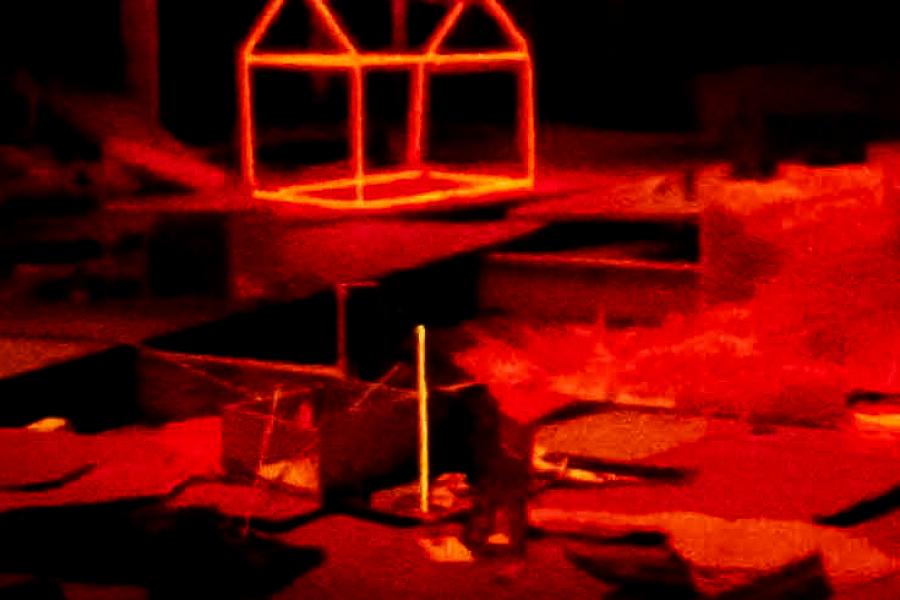
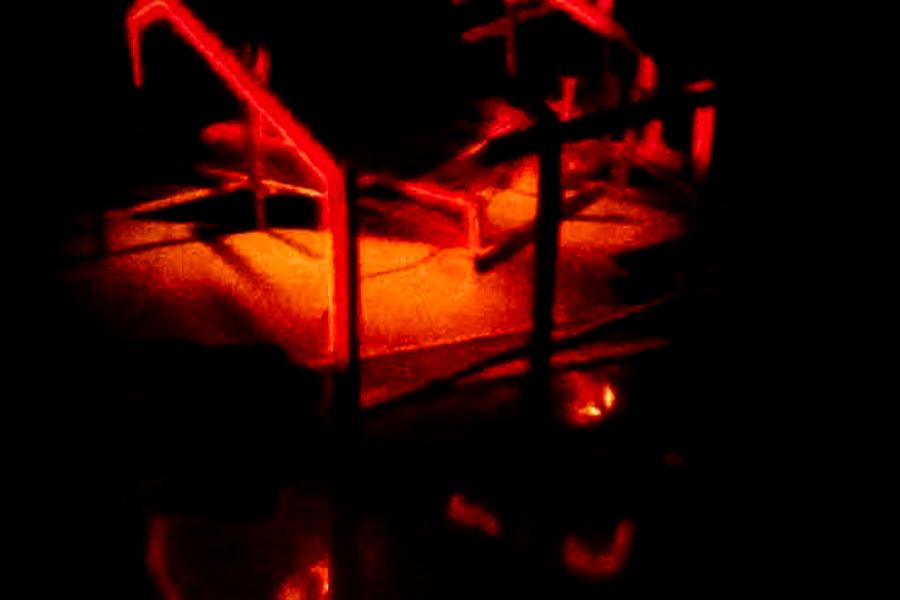
Late in the second week, the ‘neon man’ arrived. By mid-afternoon, the gallery space was aglow with dripping strands of red neon, hanging from the beams of the shed and angled strips attached to the corners and sides. A miniature house, entirely of neon, perched jauntily in the interior.
Additional small-scale dioramas sprang up around and through the structure. I began to realize that all of the materials used by the artist were industrially manufactured, all related to the construction of buildings, all man-made and indicative of an advanced civilization. However, the artist appeared intent on imposing a randomness to the overall installation. Shingles cascaded from the roof boards into the interior space at the rear of the shed, wall sheathing was cut into curves and odd angles, and pieces were attached to the uprights in a haphazard fashion. The viewer saw a chaos that was not threatening but nevertheless disturbing. Could this be an attempt to restore the ‘natural’ to the environment? I speculated that he was searching beyond the mechanical, seeking a spiritual connection that had been removed.
For centuries, Buddhist monks have practiced the art of sand painting mandalas. They invest considerable time and effort in these intricate creations, knowing they will be destroyed. Such is life, so they say. Could it be that Shepley was staging a version of a mandala for us, allowing us to view an individual’s search for completeness?
Following the public viewing reception and artist’s talk on March 18, the installation began its descending spiral. As if the world had suddenly tilted, the entire installation appeared to have been sheared in half horizontally, and the top half of the shed came to rest to the left of the base. Shingles, pink insulation, and particleboard mushroomed out across the floor as the neon continued its steady glow. Gradually, the smaller elements disappeared as the artist slowly dismantled the piece. Finally, the shed vanished into a waiting truck, leaving only the small red neon house. The warm light seemed to circle the space, probing the corners in search of the former construction.
In the window, a 47" circle of fine sand appeared, and perched atop was a small ceramic building of European design. Suggestive of castles in the sand, we are reminded of the passage of time, the erosive power of the elements, and the selectiveness of memory."*