
On this page

Overview

  • Our goals

    The Vision and Mobility Lab aims to advance the understanding of the fundamental visuomotor processes involved in the control of human locomotion and mobility, and how such processes change with aging, disease, and exercise. The labs work helps inform the diagnosis of individuals at risk for falls and the design of interventions to promote safe mobility within both clinical and nonclinical populations.

  • Key areas of research

    • Human locomotion
    • Visuomotor processes
    • Visual information intergration
    • Effects of aging, exercise and disease on locomotion

Investigators

  • Veronica Silva

    Primary investigator

    Dr. Veronica Silva's research focuses on understanding the visuomotor processes involved in controlling human locomotion and mobility across the lifespan. Silva holds a PhD in Kinesiology from the University of Waterloo, where her doctoral research investigated the role of visual information during stair locomotion.

  • Students

Projects

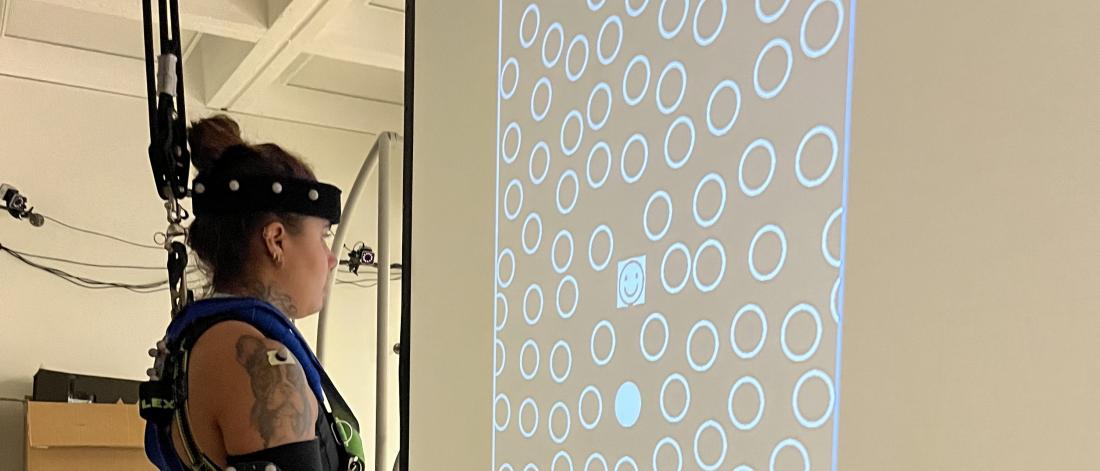
Functional Field of View during locomotion

This study focuses on examining the influence of distracted walking on the functional field of view (FFOV) in young, middle-aged, and older adults. To achieve our research goals, we record and analyze whole-body kinematics, eye movements, the functional field of view and dual-tasking cost.

Outdoor Mobility

As we age, our reliance on vision increases, and we may experience difficulty adapting our gait pattern to changes in terrain and cognitive demands. This project aims to investigate the impact of dual-task and environmental demands on gait. We utilize wearable devices, including eye trackers and inertial measurement units (IMUs) to record vision and mobility while on various indoor and outdoor terrains.

Role of Visual Processing on Locomotion Explored via Dual-Task Methodology

This project explores the cognitive and motor impact of visual secondary tasks on challenging gait in young and older adults. Through a series of experiments, we will investigate the role of vision when performing a complex locomotion task (multiple obstacle crossing). We will also assess the impact of dual-tasking and ageing on gaze behaviour and gait when crossing multiple obstacles.