




















The hallmark of the Woodland Period in the Boreal Forest is the appearance of ceramics. The technique of pottery making was introduced into the northern Shield regions by Native peoples from the Eastern United States and spread northward as far as Southern Indian Lake and as far west as Sturgeon Weir River, Saskatchewan. The Aboriginal ceramic industry was only one component of complex culture that was adapted to the forest. In Minnesota, sites containing Laurel pottery were located on the northern edge of an area that saw the development of horticulture, the construction of burial and ceremonial mounds, and the proliferation of trade networks. At the Wanipigow Site , east of Lake Winnipeg, pottery making and wild rice harvesting provide detailed evidence of Laurel subsistence activities and culture patterns.

The Laurel artifact assemblage is associated with the Boreal Forest of Manitoba, Saskatchewan and northwestern Ontario, and the Great Lakes Forest of Ontario and northern Minnesota. This region is noted for the diversity of plants and animals. The pine-hardwood forests at the Lake Superior edge yield a number of plant foods such as nuts, berries and wild rice. The multitude of lakes and rivers support many localized communities of plants and animals, including wild rice, spawning fish, migratory waterfowl, moose, deer, caribou, bear, beaver, and hare.
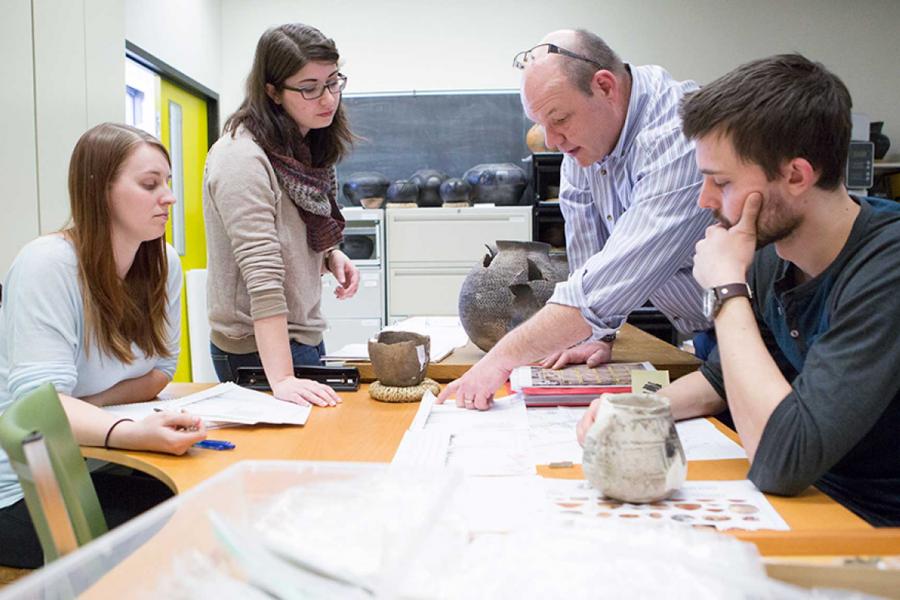
The pottery that the Laurel people manufactured serves as a primary cultural indicator. The pots were conical in shape and were made from clay that was mixed with particles of finely-crushed rock, or "temper", which played a crucial role in the firing process. The crushed rock particles relieved the stress on the clay as it expanded and shrank during heating and cooling. The pots were decorated around the rim with stamped or impressed designs. The body of the pot was plain (Pettipas and Mantey, 1996). Laurel people also made use of a variety of projectile points types ranging from side-notched and stemmed to triangular forms. Toggle head harpoons used for fishing were an important part of the tool kit as were awls, chisels, scrapers, beads, and copper.
| The Laurel peoples of the forests relied on a subsistence and settlement pattern which involved seasonal movement between the deep forest and its more open margins. Fish were an important resource as indicated by the presence of bone harpoon heads at Laurel sites. The spring and summer activities involved fishing for sturgeon, pickerel and suckers and the aggregation of large groups of people at the massive fish runs during spawning. In the fall, fish spawning and wild rice harvesting also attracted groups of people, although probably not in as large numbers as during the summer months.(Meyer and Hamilton 1994:105). In the late autumn and the winter, bands broke up into smaller family units and dispersed to make use of the more scattered animal resources. Archaeological sites for winter camps are difficult to locate. |
|
|
Pictographs on a granite rock face |
Laurel groups devoted considerable energy and attention to honouring the dead through construction of burial mounds. They are also the probable originators of the coloured pictographs painted on numerous rock surfaces through which they communicated with the spiritual world. |
View a Laurel Site at Wanipigow