Prairie Prestige Digital Collections

Arnold O. Brigden

View the digitized material
Read the fonds description

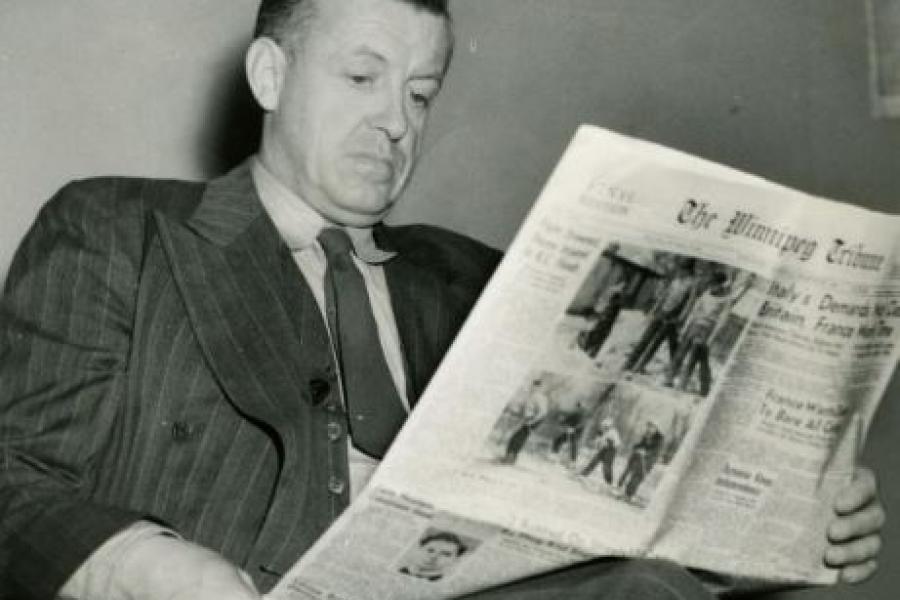
 Arnold O. Brigden (R) and uncle Frederick Brigden Sr. (WAG - Brigden-PH12_2_5C) Arnold O. Brigden came to Canada from England in 1903 to live in Toronto with his uncle, Frederick Brigden Sr., who taught him the craft of wood engraving and the emerging craft of photo-engraving. In 1910, he went to New York City to work for Gills, a large graphic arts firm.  In 1911, Frederick Brigden Sr. established Brigdens Limited, in Toronto, and in 1914 the Winnipeg branch opened. In 1914, his nephew Arnold O. Brigden was sent to manage this recently opened Winnipeg location, which evolved into the separate firm of Brigdens of Winnipeg Limited.  He quickly made it into a major commercial art producer in the Canadian West and, upon his retirement several decades later in 1956, it was one of Canada’s oldest graphic design firms.
Arnold O. Brigden (R) and uncle Frederick Brigden Sr. (WAG - Brigden-PH12_2_5C)

Located on the top three floors of the Farmer’s Advocate Building at the corner of Langside Street and Notre Dame Avenue, the initial mandate of the company’s existence was to produce the western edition of Eaton’s mail-order catalogue.  It was a monumental task; Brigdens of Winnipeg had to hire 60 to 100 artists as well as retain the services of specialized artists in Chicago and New York City.  Although there were other assignments, the artists worked to deadline around the two Eaton’s catalogues produced per year, providing depictions of dry goods, furniture, hardware, and fashion.  

Various printing techniques were used, ranging from wood engraving to lithographic processes.  The artists showed great skill in pen and ink drawing and brushwork. Each page of the catalogue was treated as a poster, and addressed graphic design concerns such as drawings, title placement, textual information, calligraphy, and black and white space, as determined by the artistic director.

 Wood engraving of stove in Eaton's catalogue (WAG - Brigden-PR5_1_9_1C)

Wood engraving of stove in Eaton's catalogue (WAG - Brigden-PR5_1_9_1C)

Arnold O. Brigden nurtured a strong artistic environment and respected the artistic process.  He hired artists to work for him for over four decades, including many women artists, including Pauline Boutal, because as mothers and non-career women, they could fit in part-time work.

In the days before art council grants and tenured positions in art faculties, places like Brigdens in Winnipeg, like its counterparts Notmans in Montreal and Grip in Toronto, allowed artists to survive financially while working in an art-related field.  Brigdens was the link between the commercial art illustrating world and the academic visual arts, with the Brigden family encouraging its employees to pursue fine arts endeavours and studies (even paying their tuition), outside of work at the Winnipeg Art Gallery and the Winnipeg School of Art.  For many years, A.O. Brigden was a member of the Winnipeg School of Art’s Art Committee and was an avid art collector of both national and local Manitoba artists.  He donated most of his collection to the Winnipeg Art Gallery.  Angus Shortt, who apprenticed with Brigdens as a wood engraver, was one of the firm’s artists  who was sent to study at the Winnipeg School of Art under Professor L. LeMoine FitzGerald, another former Brigdens employee.  Artistic reputations flourished in these hothouses, affecting the social and cultural history of the city as well as the nation, launching the careers of many artists. 

Some of the artists employed by Brigdens who went on to national and international prominence -- achieving careers as painters and teachers -- were Henry Eric Bergman, Charles Fraser, Phillip Surrey, W. J. Phillips and Charles Comfort, one of Canada’s most well known Social Realists, who went on to paint the murals in the Toronto Stock Exchange and become the director of the National Gallery of Canada.  Other Brigdens alumni include Fritz Brandtner, who used Expressionism to promote Modernism and more European avant-garde styles, first in Winnipeg and later nationally; Gordon Smith, who became one of Canada's most respected abstract painters;  Hal Foster, who illustrated Tarzan comics and Prince Valiant books; Charlie Thorson, who worked for Disney and Warner Brothers studios and created the original design conceptions for Snow White, Bugs Bunny and the early versions of  Mighty Mouse (Sniffles); and L. LeMoine FitzGerald, who went on to join the Group of Seven.

Digital Collections

Home