
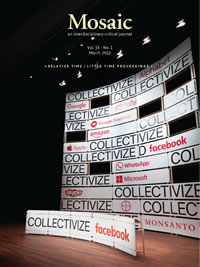
Special Issue: Relative Time/Little Time I
This is the first of two special issues featuring the proceedings of the online conference Relative Time/Little Time, developed in collaboration with the Dutch artist duo Bik Van der Pol.
Issue 55.1, 12 essays, 176 pages, $24.95 CAD
March 2022 (Current Issue)

General Issue
Featuring the work of Rodney Graham on its cover and a discography by David Wisdom based on conversations with the late artist, Mosaic 54.4 includes essays on Nordic Noir, shame culture, heterotopia, trauma, celebrity, ontological angst, and dystopian athletics.
Issue 54.4, 9 essays, 176 pages, $24.95 CAD
December 2021
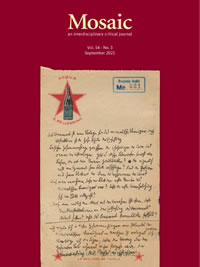
Special Issue: Featuring: Frédéric Neyrat
Mosaic issue 54.3 is a special author issue featuring the work of Frédéric Neyrat and including essays by Naomi Mandell, Sue Lovell, Gi Taek Ryoo, and Andrew Haas. Alongside two essays by Neyrat, you will find an interview focussing on the philosopher’s book, The Unconstructable Earth (2019), and you will encounter Arne De Boever’s introduction to Neyrat’s wider project via what he describes as “philosophy’s ins—and especially its outs.”
Issue 54.3, 8 essays, 180 pages, $24.95 CAD
September 2021
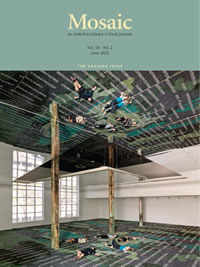
Special Issue: The Archive Issue
Mosaic issue 54.2 is a special archival issue developed as the first part of a collaborative project with the Dutch artist team Bik Van der Pol. Sifting through fifty odd years of old issues and forty times as many published essays, we selected twelve to republish. The second part of the project involves a series of lectures that will be published in a subsequent issue (55.1).
Issue 54.2, 12 essays, 236 pages, $24.95 CAD
June 2021
Get Mosaic
Subscribe to Mosaic to have the latest issues shipped to you as soon as they are published. Or order the specific issues you want. Be sure to check out our special offer!
Find Issues
View a list of current and past issues of Mosaic, both special and general issues. Read issue summaries or access issue details including the introduction and essay abstracts.
Contribute
Learn about the submission and peer review process at Mosaic. Submit an essay for consideration using our web portal where you can also check the status of your submissions and reviews.
Get Connected
Find out when new and exciting things happen at Mosaic, such
as new issues, calls for submissions, and events. Use your favorite
RSS reader to connect to our news feed: 
Or keep up to date via email:
Partner Offers