|
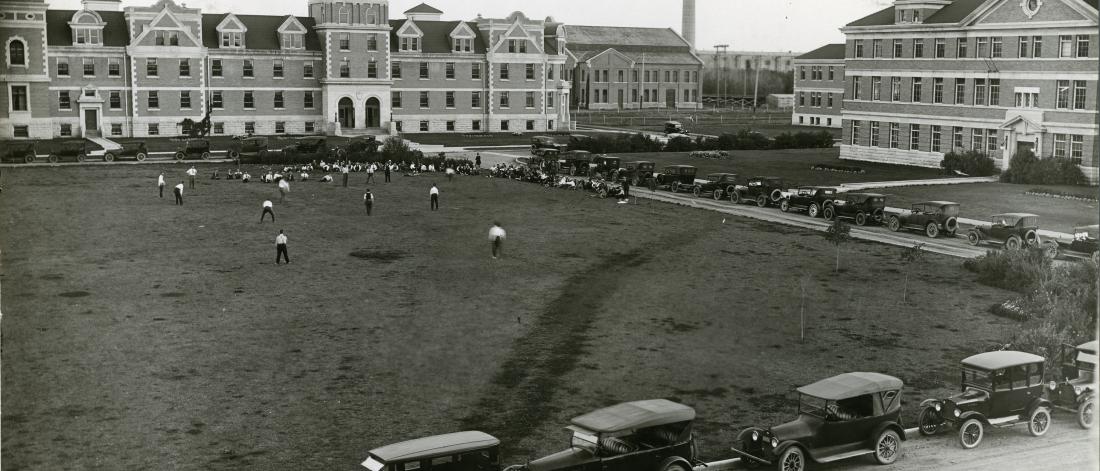
The Brown and Gold, Volume 14, 1933 |
Virtually everything for which Marshall McLuhan became internationally renowned was already evident in his public writings as a young man living in Winnipeg and studying at the University of Manitoba.
Between 1930 and 1934 McLuhan wrote several articles for The Manitoban, the student newspaper founded in 1914 and still published today, and two essays for ‘toba, a now extinct literary journal. Little can be said of the mind, heart, temperament and world view of Marshall McLuhan – perhaps nothing – that wasn’t already evident in those few writings. Perhaps most striking, despite his being a brilliant student, was McLuhan’s early disdain for formal, utilitarian methods of academic enquiry. He goes so far as to ridicule intellectual scholasticism in such articles as “Adult Education”, “Public School Education”, and “Interview with Dr. Johnson”. Instead, McLuhan the student leans towards unfettered and unstructured exploration of whatever catches one’s attention or strikes one’s interest, as in the article “German Character.” |
Yet paradoxically, as in “Germany and Internationalism” and “Macaulay – What a Man” McLuhan speaks the language of his culture, taking delight in using self-evident hyperbole, and having a natural penchant for pithy aphorisms.
Foreshadowing his often self-deprecating wit that so baffled both his admirers and critics, he writes “Morticians and Cosmeticians” with a mock confidence and bravado.
Not lacking in either authenticity or courage, McLuhan, even at an early age, delights in being a contrarian, a provocateur, as evidenced in a number of articles but particularly in “Germany and Internationalism”, and “George Meredith, Feminist?”.
Despite eventually becoming somewhat of a performance artist who enjoyed the limelight of public exposure, McLuhan at first obscured his deeply personal leanings towards religious conviction. However, there is strong evidence, even in his public writings as a student, that his soul was stirring in towards religious beliefs that eventually formed his world view. See his article on “Not Spiritualism but Spiritism “ and “De Valera”, his reference to G.K. Chesterton in “The Morticians”, his definition of agnosticism in “Germany and Internationalism”, and his allusion to moral principles in “The Groupers”.
Finally, the young Marshall McLuhan was a proud Manitoban, profoundly enamoured of the Prairie skies, and with high hopes for Canada to take its place among the cultured nations of the world. This he illustrated in the two extant essays in a literary journal, “Heaven’s Above!” and “A Grand Tour for $300”.
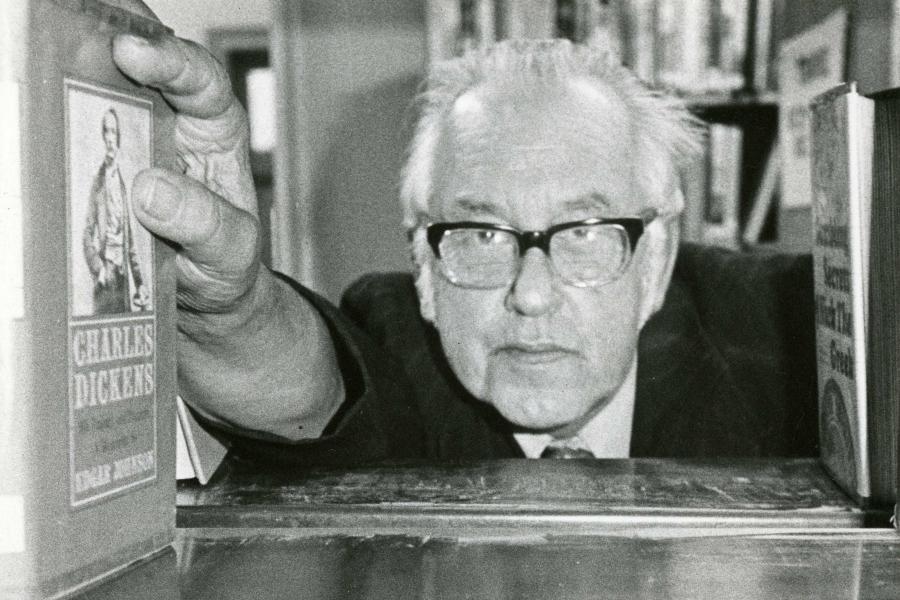
McLuhan is widely recognized as the pioneer of contemporary media studies, including media literacy, who coined or popularized such phrases as the Global Village and the Medium is the Message. He was brought up in the Fort Rouge area of Winnipeg and received his Bachelor’s and Master’s degrees from the University of Manitoba. This year, his life and work are being celebrated from Bangkok to Brussels to Berlin.
Herbert Marshall McLuhan (1911-1980), eventually earned a PhD from Cambridge University, and became a professor of English literature, prophetic poet, satirist and renowned communications visionary and media commentator.
Credit: RJ (Richard) Osicki
All McLuhan articles are under copyright of the Estate of Marshall McLuhan and are published here with the support of the Estate.
Read samples of McLuhan’s public writing as a student in Winnipeg
View full editions of The Manitoban containing Marshall McLuhan articles at Manitobia.ca
Contribute to the digitization of The Manitoban for the McLuhan Centenary