
Events
Speaker Series
The Centre on Aging hosts a Speaker Series, which regularly is held from October to March during the academic year.
Join us as the Centre's on Aging's Speaker Series presents various aging related presentation online.
As part of the Centre on Aging's outreach to the community, the Centre hosts a Speaker Series, which gives our Research Affiliates an opportunity to share insights into their academic research in aging related fields and discuss current issues.
A goal of this series is to strengthen interdisciplinary research in health and aging.
The Speaker Series is free to attend and all are welcome.
Future presentations
Thank you to all of this year's presenters. Join us again in Fall 2024 for future presentations.
Past Speaker Series presentations
Wednesday, March 27, 2024
Intersectional approaches to understanding heterogeneity of cognition aging: A data-driven exploration
Dr. Sunmee Kim
Assistant Professor, Faculty of Arts, Psychology
Friday, March 1, 2024
Reinforcing the Rainbow: Enhancing Inclusivity for LGBTQ2S+ Seniors
Dr. Robert Mizzi
Canada Research Chair and Associate Professor; Educational Administration, Foundations & Psychology
Monday, February 12, 2024
Casting light on the genetics of age-related hearing loss: Insights from the Canadian Longitudinal Study on Aging
Dr. Britt Drögemöller
Canada Research Chair in Pharmacogenomics and Precision Medicine; Assistant professor, Max Rady College of Medicine, Biochemistry and Medical Genetics
Thursday, January 18, 2024
Tech-enabled homes: Aging in place and space
Dr. Jacquie Ripat
Associate dean (research); Associate professor, College of Rehabilitation Sciences, Department of Occupational Therapy
Wednesday, November 29, 2023
Timing perceptual decision making in a mouse model of aging: Computational approaches to linking cognitive function to its neurobiological correlates
Dr. Fuat Balci, PhD
Associate Professor, Faculty of Science, Biological Sciences
Research in Aging Workshop Series
The workshops are open to students, post-docs, research staff, and faculty interested in aging research. Workshops will take place virtually and are one hour. The sessions are free to attend, but registration will be required.
Online presentations
Meetings will be hosted via Zoom and registration is required to participate. Registration details will be made available closer to presentation dates.
For members of the Students Targeting Aging Research (STAR) group, the workshops can be counted towards your co-curricular record.
Upcoming presentation
Wednesday, May 15, 2024
Introduction to research project management
Nicole J Dunn, MA, Associate Director, Centre on Aging
12–1 p.m. | via Zoom
Download poster (PDF)
Research projects have multiple tasks and deadlines, but how do you keep it all organized? This workshop will provide practical information and tips for those who are managing a research project. Based on the principals of project management, we will explore strategies, tools, and basic skills to manage any sized research project through the research process.
Future presentations
Wednesday, May 29, 2024
Leveraging media relations for knowledge translation
Eleanor Coopsammy, Director, Media Relations and Issues Management
Fiona Odlum, Media Relations officer
1–2 p.m. | via Zoom
Download poster (PDF)
If you’re a student, post-doc, researcher or faculty member working in aging research, the media wants to speak with you. Find out how the UM Media Relations team can help you connect with local, national and international media outlets. Share your knowledge, research and expertise to pique the interest of the public and potential collaborators.
Tuesday, June 4, 2024
Supporting Collaborative Research and Innovation
Yvette Shang, Senior Advisor for Business Development, Mitacs
10– a.m. | via Zoom
Download poster (PDF)
Mitacs is a national not-for-profit funding agency that promotes and funds industry-academia collaboration on research and innovation. This workshop is to introduce Mitacs flagship programs to the Centre on Aging researchers so that they could benefit from the funding program, build partnerships with industry and have their trainees funded. A Q&A session will be followed after the presentation.
Past workshop presentations | 2023–2024
Tuesday, September 26, 2023
Introduction to conducting research with older adults
Nicole Dunn, MA, Associate Director, Centre on Aging
Monday, October 30, 2023
Making and tracing the real you in digital scholarship
Andrea Szwajcer, Research Services Librarian, University of Manitoba
Monday, December 4, 2023
Communication is key—Part 2: How to communicate with older people
Christina Lengyel, PhD, RD, Professor, Faculty of Agricultural and Food Sciences, Food and Human Nutritional Sciences
Thursday, January 25, 2024
Conducting research in aging and technology
Zahra Moussavi, Ph.D., P.Eng., Canada Research Chair Tier I in Biomedical Engineering; Professor, Department of Electrical and Computer Engineering
Friday, February 2, 2024
Involving family in research on aging
Heather Campbell-Enns, PhD
Associate Professor of Psychology, Canadian Mennonite University
Thursday, March 28, 2024
Ethical considerations in aging research
Kerstin Roger, PhD
Professor, Rady Faculty of Health Sciences, Community Health Sciences
Tuesday, April 9, 2024
The A-B-C’s of presenting and designing research posters
Nicole Dunn, MA, Associate Director, Centre on Aging
Rachel Ines, BA, Dipl.(Hons.), Administration and Communications Coordinator, Centre on Aging
Aneet Saran, PhD student, Faculty of Arts, Psychology
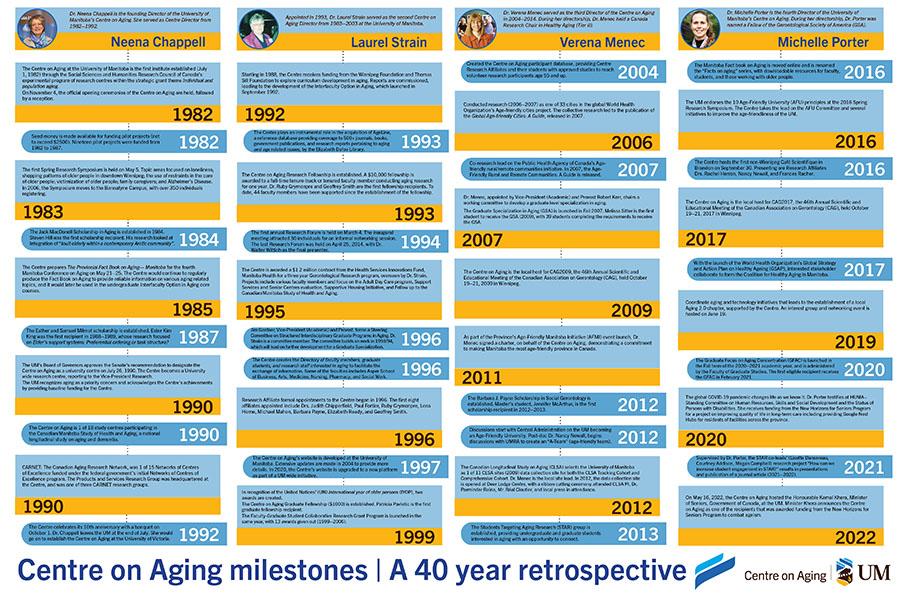
Centre on Aging 40 years
July 1, 2022 marked the Centre on Aging's 40th year at the University of Manitoba. Established by founding Director, Dr. Neena Chappell, the Centre on Aging continued to thrive under directors Drs. Laurel Strain, Verena Menec, and current Director, Dr. Michelle Porter.
Highlighted are the Centre's accomplishments over the last 40 years (PDF).
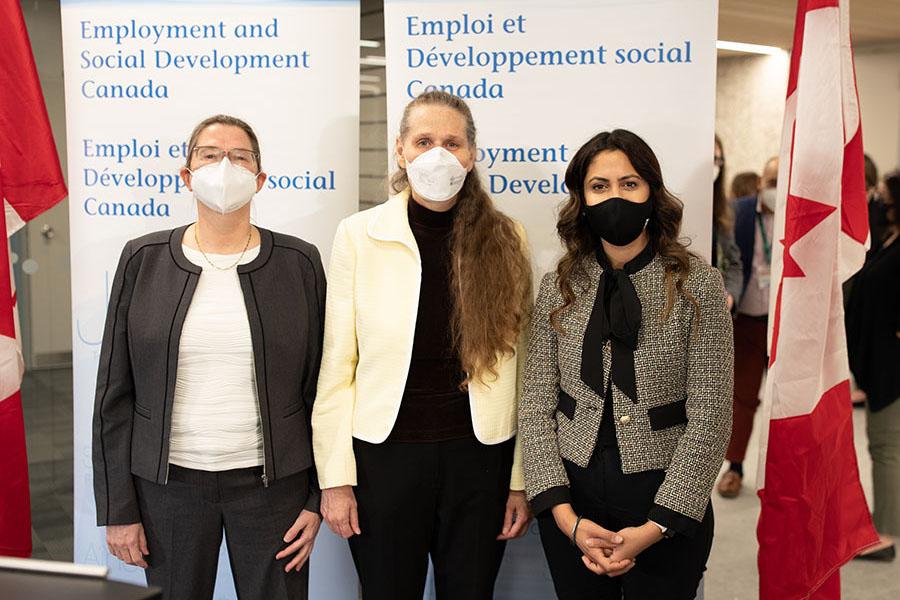
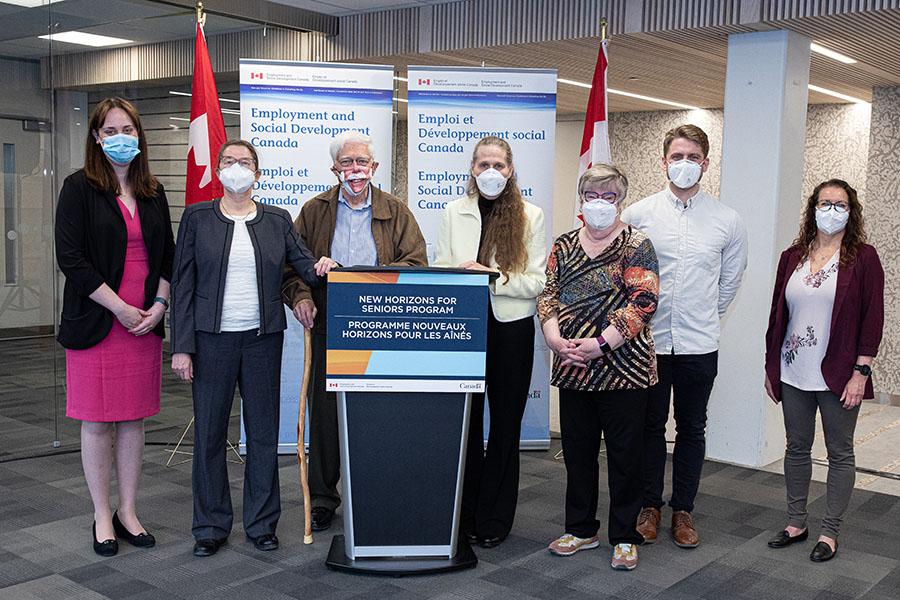
New Horizons funding announcement: Decreasing internalized ageism
On May 16, 2022 the Centre on Aging hosted the Honourable Kamal Khera, Minister of Seniors, Government of Canada, at the University of Manitoba where she announced that the Centre on Aging was one of the recipients that was awarded funding from the New Horizons for Seniors Program. The New Horizons program included $61 million in funding for more than 3000 community-based projects across Canada.
Prior to the announcement, members of the Manitoba Seniors Coalition met briefly with Minister Khera and to take some photos. Addressing the audience, were Centre Director, Dr. Michelle Porter; Dr. Annemike Farenhorst (Associate Vice-President Research, University of Manitoba); and Minister Khera, who highlighted the important research conducted at the Centre on Aging and the need to combat ageism.
Partnering with community organizations, the Centre will be using this funding to develop an intervention aimed at decreasing internalized ageism and its potentially detrimental effects among older adult community members.
We are sincerely thankful to the Honourable Kamal Khera and the Government of Canada for making this project possible. The archived announcement, can be viewed on the Seniors in Canada Facebook page.
—Dallas Murphy, Student Research Assistant, Centre on Aging
Community workshops
To see reports associated with past events of the Centre on Aging visit our Publications page.
Check back for future events.
Contact us
Centre on Aging
338 Isbister Building
183 Dafoe Rd
University of Manitoba (Fort Garry campus)
Winnipeg, MB R3T 2N2 Canada
204-474-8754
Monday to Friday, 8 am to 4 pm